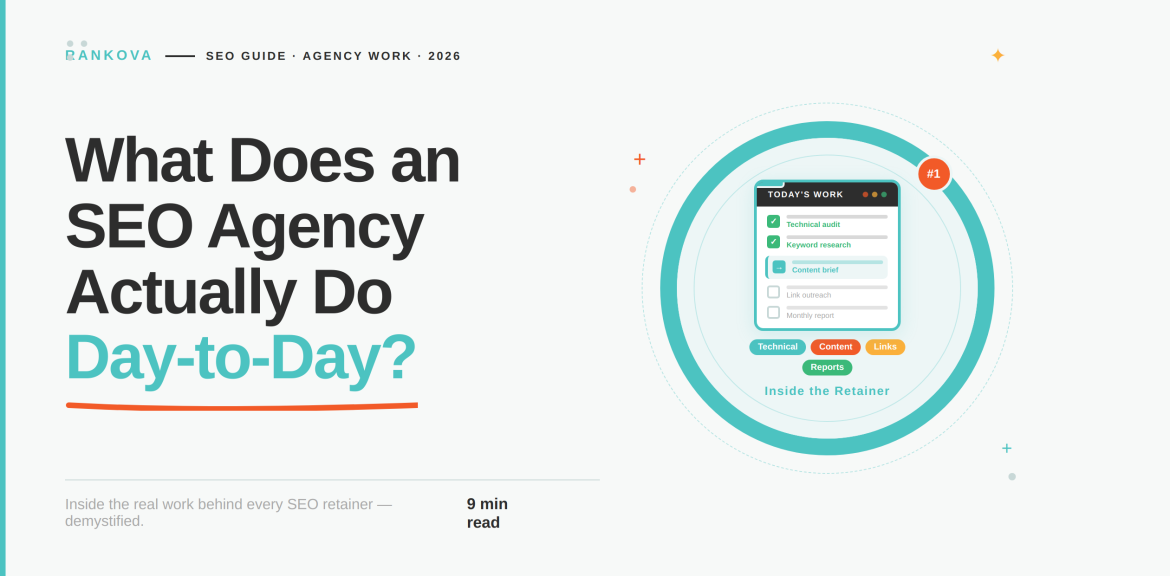
You are paying an SEO agency a monthly retainer. However, most months you get a report, a call, and maybe a vague sense that “things are moving.” However, the fair question in your mind is: what does an SEO agency actually do day-to-day?
The honest answer is that a good SEO agency’s day-to-day looks less like a single job with other activities. Let me explain. Every SEO agency practices technical fixes, content production, link building, reporting, and helping businesses show up in AI answers. Most of it is invisible until it compounds into a ranking that wasn’t there before.
This guide walks through what an SEO agency actually does day-to-day. It details what’s changed with AI Overviews, like ChatGPT and Perplexity.
Quick answer
An SEO agency runs a mix of daily monitoring (rankings, traffic, technical errors), weekly execution (content production, link outreach, on-page fixes), and monthly strategic work (audits, reporting, roadmap updates). Similarly, they optimize for AI-generated answers alongside traditional search results. However, their specific activities depend on your site’s size, industry, and how competitive your keywords are.
What Does an SEO Agency Do Daily?
Many people attempt to answer the “What does an SEO agency do?” question by mentioning keyword research, content, links, technical stuff. Some can even dress up a sales pitch as an explanation. However, is that enough?
The honest reason it’s hard to summarize is that SEO isn’t one activity. Yes, it’s the sum of a lot of small but unglamorous ones spread across different disciplines. For example, it involves technical work, editorial content work, outreach and relationship work, and a focus on how AI tools summarize and cite your business. A serious agency like Rankova is running all four at once, at different speeds, for every client.
That’s also why “we’ll get you to #1” is a red flag rather than a promise. No single task moves a keyword. It’s the accumulation of dozens of small yet correct decisions made consistently over months.
What Happens Daily, Weekly, and Monthly
The clearest way to understand the job is by how often each piece of work happens. Let’s examine how each period works;
- Daily
- Monitoring rankings and traffic
Pulling position and traffic data for priority keywords. The goal is to catch sudden drops early because a keyword can fall overnight. That usually means something specific broke and not that “SEO stopped working.”
- Checking Google Search Console and analytics for errors.
Check if crawl errors, indexing issues, sudden changes in impressions, and server errors are flagged here.
- Watching for algorithm updates.
Google rolls out updates constantly, and most don’t matter to a given site.
- Responding to client questions and fires.
Sometimes, day-to-day work can include responding to a client’s complaints. Common cases are that a page went down, a competitor launched something, or a journalist wants a quote.
- Weekly
- Content production.
Briefs get written, drafts get reviewed, and pieces move from outline to published. Most agencies are running several pieces through this pipeline simultaneously, at different stages.
- On-page optimization.
Updating title tags, meta descriptions, header structure, and internal links on both new and existing pages. This is usually based on what’s currently working in search results.
- Link building and digital PR outreach.
Sending pitches, following up, and building the relationships that eventually turn into backlinks. This high-volume work can involve dozens of outreach emails for a handful of eventual links.
- Technical fixes.
This is working through the backlog from the daily error monitoring, broken redirects, slow-loading pages. It also involves coordinating with developers when a fix needs to happen on the client’s side.
- Competitor tracking.
Checking what’s newly ranking for target keywords and whether a competitor published something that needs a response.
- Monthly
- Reporting and the client call.
Pulling together what changed with ranking movement, traffic changes, content published, links earned, and what’s planned next. This is the visible tip of the work described above.
- Performance review against goals.
Comparing actual movement to the targets set at the start of the engagement. You should also adjust the plan if something isn’t working the way it was expected to.
- Content and keyword gap analysis.
Reassessing what’s ranking, what’s not, and where new opportunities have opened up since last month.
- Backlink and technical health checks.
This is a broader sweep than the weekly fixes. It also involves looking for anything that’s degraded slowly enough to not trigger a daily alert.
Quarterly and Ongoing
- Full site audits.
This is a deeper technical and content review than the monthly check-ins. It usually the point where bigger structural recommendations come out.
- Strategy resets.
Revisiting the keyword and content strategy against how the market, the client’s business, and the search space itself have shifted.
- Roadmap updates.
Adjusting priorities for the next quarter based on what moved, what didn’t, and what’s newly worth pursuing.
If you’re the one hiring the agency, it’s worth putting your expectation of it in writing before work starts. Our guide on how to write a brief for an SEO agency covers what to specify. This is to ensure you’re not guessing at what “day-to-day work” is supposed to look like for your account.
Who’s Doing This Work
Smaller agencies often have one person doing all of these while larger ones split them into dedicated roles:
- SEO strategist or account lead: Owns the overall plan, the client relationship, and the monthly reporting. They are usually the person on your calls.
- Technical SEO specialist: Handles crawlability, indexing, site speed, structured data, and the more engineering-adjacent side of the work.
- Content strategist and writers: Research keywords and search intent, brief out content, and produce or edit the pages themselves.
- Link building specialist: Runs outreach, builds relationships with journalists and other sites, and secures the backlinks that support authority.
- AEO specialist: They focus on how to represent a business in AI Overviews, ChatGPT, Perplexity, and other answer engines.
- Analyst: Owns the dashboards, reporting, and the numbers that back up (or contradict) what everyone else believes is working.
A one- or two-person agency isn’t necessarily worse. However, it means the same person is context-switching between all of the above. When you know this, you can evaluate how much attention your account is getting.
What This Looks Like From the Client’s Side
Most of what’s described above is invisible to a client by design. Of course, you’re not meant to see the outreach emails or the redirect map. What you should actually see:
- A monthly (at minimum) report that connects specific work to specific results. Note that this is not just a dashboard screenshot.
- A visible content calendar or pipeline, so you know what’s in progress.
- Clear communication when something isn’t working, before you have to ask why.
- A roadmap that changes over time.
If your monthly report only has vanity metrics with no connection to specific actions, that’s usually a sign of bad day-to-day work structure.
How AEO and GEO Have Changed the Day-to-Day
Traditional SEO work optimizes a site to rank on Google’s front pages. However, AEO (Answer Engine Optimization) and GEO (Generative Engine Optimization) optimize the same site to ensure it shows inside AI-generated answers. These include Google’s AI Overviews, a ChatGPT response, or a Perplexity summary. We’ve broken down exactly how these three disciplines differ in GEO vs. SEO vs. AEO. Here’s what it adds to the daily and weekly workload:
- Monitoring AI referral traffic and citations.
- Structuring content so it’s extractable by AI chatbots.
- Checking how a business is represented when someone asks ChatGPT or Perplexity about it directly.
- Building and maintaining structured data and schema markup
- Reporting on a different set of metrics.
Note that these don’t replace traditional SEO work. Rather, it runs alongside it to increase the business’ visibility.
What a Good SEO Agency Does Not Do
It’s important to be clear about the boundaries. This will help you avoid a lot of the confusion around “what does an SEO agency do?” Examples include;
- Guarantee a #1 ranking: There is no agency that controls Google’s algorithm. So, anyone promising a specific rank on a specific date plans to use tactics that risk a penalty.
- Work in isolation from the rest of your marketing: SEO can impact your website, your content, your product pages, and paid campaigns. An agency that never talks to your other teams is missing context that affects the work.
- Deliver results overnight: Even flawless execution takes time to show up, because search engines and AI platforms both need to recrawl and reprocess changes before rankings reflect them.
- “Set and forget:” If you optimized a site well two years ago and have not touched it, it is losing ground. The reason is that competitors keep moving and search itself keeps changing. If your rankings have been sliding and no one’s flagged it, that’s worth investigating. You need to learn about why the reason most SEO campaigns fail.
Signs You are Getting Your Money’s Worth
Here are the signs to know you are getting your money’s worth;
- You can name at least three specific things your agency worked on last month, not just “SEO stuff.”
- Your reporting connects effort to outcome.
- Someone flags problems proactively instead of you noticing a traffic drop first and asking about it.
- The strategy has visibly evolved over the last two quarters rather than repeating the same tactics.
- AI visibility (citations, AI Overview appearances, and how your business shows up in ChatGPT) is part of the conversation.
If you’re unsure whether the work being billed is actually translating into results, it’s worth looking at how that’s measured in the first place. Our guide on how to measure ROI on SEO and AEO services walks through the numbers that matter.
Frequently Asked Questions About What Does an SEO Agency Do Daily
Here are some frequently asked questions about what an SEO agency does daily;
Question 1: How many hours a week does an SEO agency spend on a client?
It varies widely by scope and site size. However, a mid-sized retainer can range between 10 and 30 hours a week spread across strategy, content, technical work, and outreach. So, you should ask your agency directly what’s included in your specific retainer, since scope varies more than most pricing pages let on.
Question 2: What’s the difference between an SEO agency and an SEO freelancer?
An agency has dedicated specialists for technical SEO, content, and link building working. They work together in a coordinated manner. However, for a freelancer, he is usually one person handling all of it, which can mean lower cost. It also means less depth in any single discipline and less capacity when multiple things need attention at once.
Question 3: How quickly should I expect to see results from an SEO agency?
You can expect to see meaningful results within two to four months. However, there will be more substantial results between six months to a year, depending on how competitive your industry is and how much work your site needed at the start. Anyone promising results in weeks on a competitive keyword is setting an expectation they likely can’t meet.
Question 4: Does an SEO agency also handle AI search optimization, or is that separate?
It depends on the agency. Traditional SEO agencies that haven’t updated their process may only track Google rankings and miss AI Overviews, ChatGPT, and Perplexity entirely. So, you should directly ask whether AEO and GEO are part of the standard scope or a separate add-on, since this is increasingly where a meaningful share of research traffic starts.
Question 5: What should I expect in a monthly SEO report?
A useful report connects specific actions to specific outcomes. This includes what was published or fixed, how rankings and traffic moved, links earned, and what’s planned next. It should go beyond a dashboard screenshot of numbers with no explanation of what drove them or what’s being done in response.
Conclusion
Day-to-day, an SEO agency’s work is mostly invisible. It involves monitoring dashboards, writing briefs, sending outreach emails, fixing redirects, and increasingly, making sure a language model can find and trust your content well enough to cite it. None of it is dramatic on its own. What matters is whether it’s happening consistently, whether it’s connected to a strategy that actually adapts, and whether someone’s paying attention to AI search alongside traditional rankings, not instead of them.
If you want a clearer look at what that work should look like for your specific site, that’s exactly the kind of conversation we have at Rankova. Get in touch. We’ll walk you through what a realistic day-to-day and a realistic result look like for your business.
If you enjoyed this, read more;
How to Measure ROI on SEO and AEO Services
The Reason Most SEO Campaigns Fail (And How to Avoid It).
GEO vs SEO vs AEO: What’s the Difference and Which One Does Your Business Need?