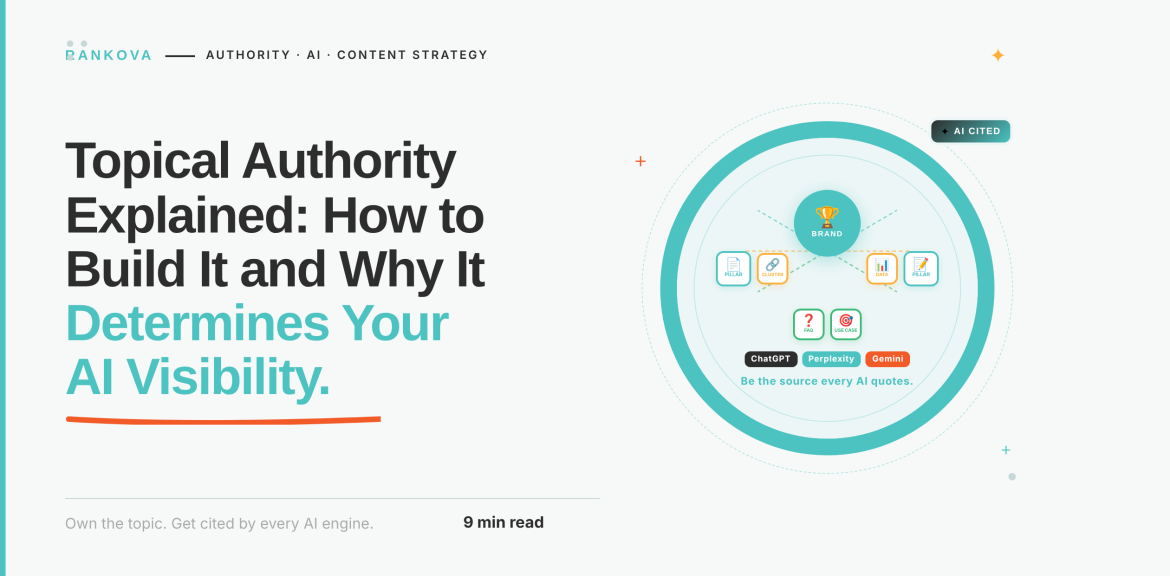
If you asked ChatGPT or Google’s AI Overview a question in your industry and your business didn’t show up, while a competitor’s did, you have already felt the effect of topical authority. However, you didn’t have a name for it yet.
That’s what this guide is about. You will learn about topical authority, the mechanism, and the plan. It begins with a plain-English explanation of what topical authority is. Then the part most guides skip entirely: the real difference between being cited by an AI tool and being named by one, and why that distinction decides whether this work pays off. Then a practical, no-expensive-tools-required process to build it, and how to tell if it’s working.
Quick Answer: What Is Topical Authority and Why Does It Matter for AI Visibility?
Topical authority is how thoroughly, consistently, and credibly your website covers a specific subject. You should note that this is not about how many pages you’ve published in total. AI tools like ChatGPT, Google AI Overviews, and Perplexity don’t rank pages the way traditional search does. They look for sources that demonstrate real, connected depth on a topic, then decide whether to link to that source (a citation) and whether to say the brand’s name out loud (a mention). Topical authority is what earns both. Without it, your content can still occasionally make it into an AI answer, but it may not include your brand. Yes, that’s the difference between an AI tool using your page and an AI tool recommending you.
What Topical Authority Means
Topical authority is the level of trust a search engine or AI system places in your site as a source on a specific subject. To build this, you need to cover that subject thoroughly rather than by publishing one strong article and hoping it carries the whole topic.
Let’s imagine two bakeries. Bakery A has a single excellent article on wedding cakes. Bakery B has a dedicated page for every cake type, a pricing guide, a page on dietary substitutions, a delivery and setup guide, and answers to the specific questions couples ask when planning a wedding.
Both bakeries might make an equally good cake. But search engines and AI tools can only judge what’s on the page. You will agree that Bakery B looks like the expert, because its content behaves as an expert’s would. They are thorough, well-connected, and anticipate the next question.
Is Topical Authority the same as Domain Authority?
People confuse these two terms constantly, and the confusion can waste one’s effort. Here is a table that spells out the difference between Topical Authority and Domain Authority;
| Topical Authority | Domain Authority | |
| What it measures | Depth of expertise on one specific subject. | General trustworthiness of the whole site. |
| Built mainly through | Connected and comprehensive content on a topic. | Backlinks, site age, and overall link profile. |
| The question it answers | “Is this site the expert on X?” | “Is this site generally credible?” |
| Relevance to AI citations | Very high | Fairly. |
You should know that a high-authority domain with a thin page on a subject can still lose an AI citation to a smaller yet focused site that covers that exact subject in depth. This is good news if you run a small or growing business. You don’t need to out-rank a giant across the board. All you need to do is out-cover them on the specific subject your customers search for.
The Difference Between AI Citation and Mention
The distinction between AI citation and mention is crucial. So, it’s worth slowing down for. When an AI tool answers a question, two different things can happen to your brand, and they are not the same. One is citation, and the other is mention.
A citation is when the AI tool links to your page as a source. You will usually see this as a small reference or footnote. That means the AI tool used your content, and a reader who clicks it lands on your site.
A mention is when the AI tool says your brand’s name directly in the answer text, with or without a link. For example, “Businesses like Rankova often offer…” is a mention. This is closer to a recommendation than a reference. Yes, that’s what most businesses mean when they imagine “showing up in ChatGPT.”
Based on research, it is important to state that ChatGPT’s behavior across hundreds of categories found that AI citations and AI mentions respond to different things. Citations spread fairly broadly. So, a brand can earn a citation even in a topic area fairly distant from their service, as long as the specific page is relevant, credible, and current.
However, mentions behave very differently. If you want an AI tool to name you, your topic must match the brand’s established area of depth. In topics close to a brand’s core expertise, the research found citations converting into a named mention roughly four times more often than in topics the brand had little depth in.
In summary, broad and scattered content can still get your pages linked occasionally. However, you need depth in a focused area to get your brand’s name out there. If your goal is “I want AI tools to recommend us,” you need to own a specific topic in its depth.
This is also why some businesses report seeing their pages quoted by AI tools without ever feeling like their brand gets “credit” for it. They’ve earned citations. They haven’t yet earned the mentions, because their coverage of the topic isn’t deep enough as an expert’s.
Why Topical Authority Determines Your AI Visibility
AI tools build their understanding of the web from patterns. If your brand’s name and your core topic appear together across multiple well-structured and genuinely useful pages, and other credible sources echo it while mentioning you in the same context, the system will learn to connect the two. So, you need that connected body of work for AI visibility.
This is also why topical authority still matters even if you’ve already done basic technical SEO, schema markup, and page-speed work. Those things make your content extractable. Topical authority helps the AI chatbots to trust your content and be able to extract from it in the first place.
How to Build Topical Authority
You don’t need an enterprise SEO platform to start this. You need a clear topic, an honest audit, and a structure. Here’s the process;
Step 1: Pick One Topic You Can Own
Choose a subject specific enough to cover completely and not your whole industry. A catering company doesn’t own “food.” It can own “corporate event catering” or “wedding catering for outdoor venues.” An accounting firm doesn’t own “finance.” It can own “small business tax compliance.”
Could you realistically answer every meaningful question a customer would ask about this specific subject without running out of things to say? If yes, the topic is good to go. If you are already stretching to fill three pages, narrow it further.
A common mistake to avoid
Avoid covering several unrelated topics at once, early on. A site that writes about wedding catering, home renovation tips, and personal finance in the same month sends a confused signal about its expertise. You get depth and breadth at the start for mentions rather than citations.
Step 2: List Every Question Before You Think About Keywords
Skip keyword tools for this step. You can start with the actual questions your customers ask in sales calls, DMs, WhatsApp or email threads, and comments on your social posts. Group them into these three stages.
- Questions people ask when they’re just learning about the topic.
- Questions they ask when comparing options
- Questions they ask right before they decide.
After this list exists, you can check a keyword tool (Google’s autocomplete and “People also ask” box work fine for free) to see if you’ve missed an obvious angle.
Step 3: Build a Simple Topic Map
You don’t need special software. A spreadsheet or even a hand-drawn diagram works.
Put your core topic at the center. That’s your pillar page, the single most complete guide to the subject on your site. Around it, list 8 to 15 cluster pages, each covering one specific subtopic in real depth. Ensure it includes a price guide, a comparison, a how-to, and a specific use case. For each one, note whether it exists yet, and whether it currently links to and from the pillar.
Step 4: Link Everything Together With Anchor Text
Every cluster page should link back to the pillar. The pillar should link out to every cluster. Related clusters should link to each other where it makes sense to a reader. Use descriptive anchor text that names what the linked page is about. This helps a human reader know what they’re clicking, and it reinforces the topic association for any system reading the page.
Check for content that exists but has no internal link pointing to it. An orphaned page is invisible to both readers and crawlers unless they stumble onto it directly.
Step 5: Write From Experience And Not Only Research
This is where most topical authority efforts fail. A cluster of ten pages that all read like competent summaries of what’s already on the internet doesn’t build authority. The reason is that there’s nothing in it that couldn’t have been generated by asking an AI tool the same question.
What earns citations and mentions is the detail only you have. This includes your pricing, a process you follow, a specific example, or an opinion grounded in doing the work.
Use research and drafting tools to move faster if you want. But the sentence that makes a page worth citing is usually the one with a number, a name, or a detail that’s yours alone.
Step 6: Build Real Off-Site Signals Around the Same Topic
On-site structure alone isn’t enough. AI systems also weigh whether your brand is credibly associated with the topic elsewhere. This can include mentions in industry publications, discussion on forums and review sites, quotes in local or trade press, and partnerships and sponsorships relevant to the subject.
If your brand’s name keeps appearing near your core topic across the web, that reinforces the same pattern an AI system learns from your own site.
Step 7: Keep It Current
Content that hasn’t been reviewed in a long time will lose ground to fresher coverage of the same subject, particularly for anything involving prices, availability, or facts that change. So, put a realistic review schedule in place, and update the page before it’s out of date.
How to Tell If It’s Working
You’re tracking two different environments, and they need different checks.
- Traditional signals.
Watch whether multiple pages from your cluster start showing up for related searches in Google Search Console. Growing impressions across a cluster of related queries is an early sign the topic association is forming.
- AI-specific signals.
Periodically ask the major AI tools (ChatGPT, Google’s AI Mode, and Perplexity) a handful of questions in your topic area. You can note these two things separately:
- Did they link to your page (a citation), and
- Did they say your brand’s name (a mention)?
Track both over time, because as the earlier section explained, they respond to different things and tell you different stories. If you’re getting cited but never named, that’s a signal to go deeper on your core topic rather than wider into new ones.
Common Mistakes That Undermine Topical Authority
Here are the common mistakes that undermine topical authority;
- Publishing thin pages to fill out the topic map: A 300-word page that barely answers the question is worse than not having the page at all. This signals shallow coverage rather than none.
- Chasing too many topics at once: Depth in one subject consistently outperforms a scattering of pages across several.
- Treating internal linking as an afterthought: A page with no links pointing to it is effectively invisible, no matter how good the content is.
- Letting the topic go stale: Freshly reviewed content has an observed advantage in AI citation behavior over content that hasn’t been touched in years.
- Writing summaries instead of sharing expertise: If a page could have been written by asking an AI tool the same question you’re answering, it won’t stand out to that same AI tool when deciding what to cite.
- Expecting fast results: This compounds over months, not days. Early search-ranking movement typically shows up before AI citation and mention patterns do.
Frequently Asked Questions About Topical Authority
Here are frequently asked questions about Topical authority;
Question 1: What is topical authority in simple terms?
Topical authority is how thoroughly and credibly your website covers one specific subject. You will build this through a connected body of content rather than a single article. The more real depth you have, the more search engines and AI tools trust you as a source on that subject.
Question 2: How is topical authority different from domain authority?
Domain authority reflects how trustworthy your whole site looks, mostly based on backlinks and site age. Topical authority is specific to one subject. A site with high domain authority but only one thin page on a topic can still lose an AI citation to a smaller site with real depth on that exact subject.
Question 3: What’s the difference between being cited and being mentioned by an AI tool?
A citation is a link the AI tool shows as a source. A mention is when the AI tool says your brand’s name directly in its answer. Citations can happen fairly broadly across topics. Mentions are about how deep your expertise is in that specific subject.
Question 4: How many pages do I need to build topical authority on a topic?
There’s no fixed number, but 8 to 15 cluster pages around one pillar page is a reasonable starting point for most small business topics. What matters more than the count is whether the cluster covers the questions a customer would ask.
Question 5: Can a small business build topical authority faster than a large competitor?
In some ways, yes. A focused site covering one subject thoroughly can out-cover a much larger competitor whose content on that same narrow subject is thin or scattered across many unrelated topics.
How Rankova Builds Topical Authority for Clients
Building topical authority isn’t a content-volume game, and it doesn’t come from one well-optimized article. It’s the result of deliberately choosing a subject, covering it the way a genuine expert would, linking it together properly, and backing it with real off-site credibility. After this, you give it the months it takes to compound.
That’s the work Rankova does for businesses. We choose the right topic to own, build the cluster around it, and track both search rankings and AI mention patterns. That way, you can see the difference between content that gets used and content that gets recommended. If you want a clearer sense of what an agency actually does week to week to build this, read what an SEO agency actually does day-to-day.
Want to know which topic your business should own, and how far you are from owning it? Talk to Rankova, and we’ll map it out with you.
Conclusion
Topical authority is not about publishing more. It’s about choosing one subject you can own and prove. The process is page by page and link by link, until the pattern is unmistakable to humans or AI. On that subject matter, your brand is the expert.
Getting your content used (a citation) and getting your brand recommended (a mention) are not the same achievement. Only depth earns your brand the mention it needs. Start narrow, go deep, link it together, and keep it current. That’s the whole method you need to repeat consistently for long enough to compound.
Reach Rankova today to handle this business for you.
If you enjoyed this, read more here;
How to Get Cited by Google AI Overviews
Internal Linking Strategy: The Most Overlooked SEO Tactic. – SEO & AI Search Optimization Agency
How to Make AI Systems Recognize and Trust Your Brand
What Is Schema Markup? A Plain-English Guide for Business Owners
How to Fix a Website That Google Won’t Index
What Does an SEO Agency Actually Do Day-to-Day? – SEO & AI Search Optimization Agency