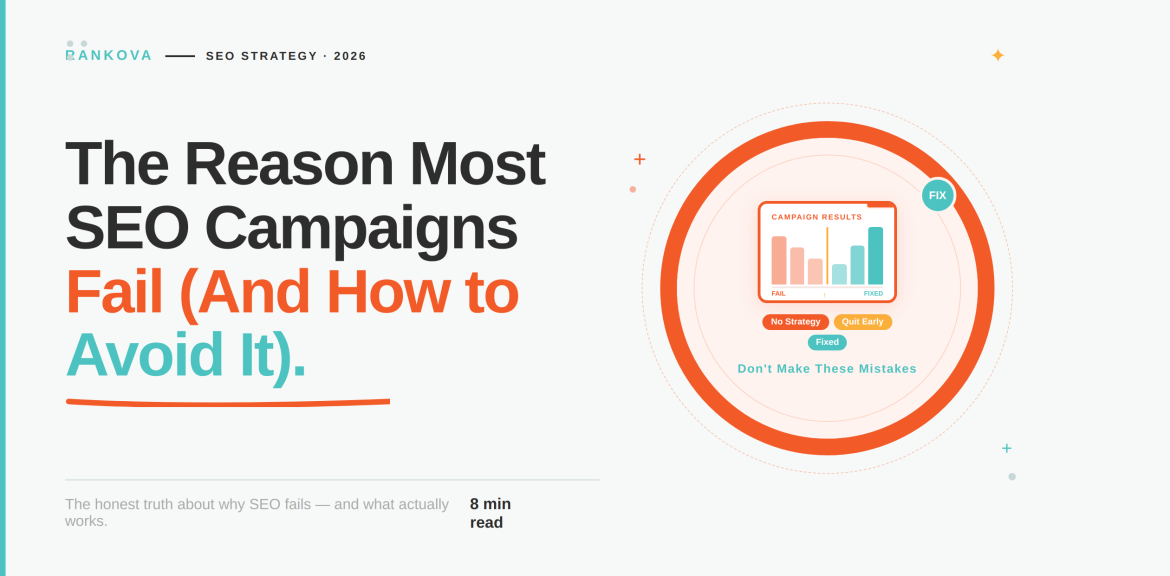
Before we begin, here is a quick exercise. Based on your experience, write down the reason most SEO campaigns fail. You can write as many options as you think are possible. By the end of this article, you will be surprised at the root cause of failure for most SEO campaigns.
As an experienced and credible SEO agency, here’s a pattern Rankova sees repeatedly from past SEO audits. A company can spend a fortune of resources and time on SEO. By month nine, their organic traffic is up by 210%. Rankings are climbing for dozens of keywords, and the agency’s dashboard is full of green arrows. However, revenue is not moving from the website, as there is not a single deal one can trace to organic search.
Well, the SEO agency isn’t lying, and they aren’t incompetent. They have genuinely delivered your goals for the campaign. But the problem is that nobody ever defined what “working” meant in the terms the business cared about. Is it about traffic, rankings, or revenue?
That’s the reason most SEO campaigns fail, and it’s the same reason so many business owners end up typing “SEO not working” into Google. It is because they did not define success for their campaign.
Don’t forget the above story, as we will come back to how it ended. Of course, Rankova changed their story. Keep reading to find out how.
Quick Answer: Why Do Most SEO Campaigns Fail?
Most SEO campaigns fail because the business and the agency never agreed on a measurable definition of success tied to revenue. As such, the campaign optimizes for traffic and rankings instead of buyers. A campaign should have clear and revenue-linked goals to ensure success.
Why Most SEO Campaigns Fail.
You can do a simple exercise to ask different businesses running an SEO campaign what success looks like. Most will say some version of “more traffic” or “better rankings.” While both are good metrics, neither of those is a business outcome. The worst thing is that the metrics are proxies for success that can drift you away from the real deal.
When you hire an agency, the fastest and most visible way to show early progress is traffic and rankings. The truth is that they move faster than revenue does, and they’re easy to report. So that’s what gets optimized for, reported on, and eventually mistaken for the goal itself. However, as traffic increases, there needs to be more leads, more filled forms, and increased sales.
Early Signs That Show Why Most SEO Campaigns Fail.
Here are early signs that show why Most SEO campaigns fail;
- Thin or generic content.
Thin content is one that answers a keyword instead of a buyer’s question. It’s usually because you are measuring the campaign by output volume or ranking position instead of the action a reader will take afterward. Fix what you are measuring, and then you will fix the content you are building alonsgide
- Technical debt.
Technical issues include slow sites, broken indexing, and weak mobile experience. The truth most people ignore about them is that they compound. However, you will only address the technical problems based on the campaign’s goals. If your metric is traffic, you might let a slow checkout page sit at the bottom of the priority list because “it’s ranking.” If your metric is revenue, you should fix that same page immediately, because it’s costing you money.
- Giving up early or late.
SEO takes months to show results, and plenty of campaigns get abandoned before they have had a fair shot. However, the inverse is just as damaging and far less discussed. You can keep a campaign running for a year past the point it should have been restructured, because “traffic is up” looks like enough evidence to keep going. Without a revenue-linked goal, you have no clear signal for when your patience turns into denial.
- Chasing competitors or chasing trends.
Copying what a competitor publishes or pivoting your whole content plan around the latest algorithm is easy to justify when you have no fixed target to measure new ideas against. Always ask, does this new tactic move that number, or is it just activity?
- Budget mismatch.
Underfunding a campaign relative to its goals is real. But your budget conversations go nowhere productive without a number to justify them against. So, have a budget based on the kind of returns you want.
Early Signs to Know Your SEO Campaign Is Failing.
If you are rereading your last SEO report to decide whether it was a success, this section is for you. Before assuming your campaign has failed, check where it actually sits against this timeline.
| Timeframe | What’s fair to expect | Warning signs |
| 0–3 months | Rankings and traffic are the only fair signals right now. | Zero movement in rankings and traffic is worth a conversation, but not yet a red flag on its own. |
| 3–6 months | Traffic trending up on at least some target pages, early movement on long-tail keywords. | If traffic is still completely flat, it becomes a real warning sign. |
| 6–9 months | Revenue-linked metrics should start showing something, even a handful of tracked leads or a rise in branded search. | Traffic is up, but there’s still zero connection to leads or sales. |
| 9+ months | A visible revenue trend tied to your tracked goal. | No revenue signal at all. At this point, more time stops being a reasonable explanation. |
If you’re already past month nine with no revenue signal, that’s worth a second opinion before you spend another quarter waiting.
Get a free SEO audit from Rankova.
How the Introductory Story Ended
Back to the story from the opening. The conversation that changed things wasn’t about content or technical fixes. Rankova redefined what “working” meant. The team set up CRM source tagging, picked the three service pages that drove revenue, and rebuilt the monthly report around tracked leads instead of traffic.
The numbers looked less impressive at first. There was reported traffic growth against a smaller set of pages. By the next reporting cycle, tracked organic leads went from zero to a growing number. This is because the strategy was now pointed at producing them, instead of being credited for growth that was never connected to revenue in the first place. In turn, they had more leads and customers.
How Rankova Builds Successful Campaigns
At Rankova, every campaign starts with a goal tied to your revenue and not just your rankings. Of course, we have seen exactly the pattern described above play out too many times to build campaigns any other way. We report on what actually moved. Our services often cover qualified leads, tracked conversions, and AI citation visibility (as buyers now rely on AI chatbots for answers). If a metric can’t be traced back to your business outcome, we don’t treat it as a win.
Book a free SEO audit with Rankova, and we will show you exactly what your current campaign is optimizing for. We will also let you know if it’s the right thing and if your business needs to do otherwise. Rankova is the best SEO agency your brand needs to attain the next targets in sales and leads.
Frequently Asked Questions About Why SEO Campaigns Fail.
Here are frequently asked questions about the reasons most SEO campaigns fail.
Question 1: What is the number one reason SEO campaigns fail?
The number one reason is that the campaign was never built around a measurable definition of success tied to revenue. Traffic and rankings become the default goal because they are easy to track early, and the campaign drifts from what the business actually needed.
Question 2: How long should I wait before deciding an SEO campaign has failed?
Give a campaign at least 6 months before drawing firm conclusions, and expect meaningful revenue-linked signals by around month 9. If there is zero movement in traffic or rankings by month 3, you can start investigating already.
Question 3: Can an SEO campaign have rising traffic and still be failing?
Yes, and it’s one of the most common ways businesses get misled. Rising traffic without any tracked connection to leads or sales means the campaign is optimizing for a proxy metric instead of the business outcome it was meant to produce. Yes, this is exactly what “SEO not generating leads” usually means in practice.
Question 4: Do AI Overviews mean SEO doesn’t work anymore?
No, but they do change what “working” looks like. Rankings and click-through rates behave differently now that many informational queries get answered directly in search results. Campaigns need to track qualified leads and AI citation visibility alongside traditional rankings to get an accurate picture.
Question 5: How do I stop my SEO campaign from failing this way?
Set a specific, measurable, and revenue-linked goal before the campaign starts. Track it with a CRM source tag and a fixed reporting date, and check regularly whether the strategy is still aimed at that number rather than just at traffic and rankings.
Question 6: What if my situation is more specific, like ecommerce or local SEO?
The root cause is the same across every business type, since the goal for every business is more sales. However, how it shows up differs. An ecommerce store might see cart-level revenue disconnected from category-page traffic, while a local business might see calls and map views disconnected from organic rankings. The solution is also the same. Tie the campaign to a revenue-relevant number that is specific to how your business converts. Track this to report success.
Conclusion
Most SEO campaigns don’t fail because someone made a technical mistake or published a weak article. They fail because nobody ever answered the one question that actually matters: what does “working” mean for this business? Everything else on the list is downstream of that missing answer.
So, fix that first, and gradually attend to the symptoms that have resulted from the previous approach. If you are still unsure about how to go about things, consult Rankova today for an SEO audit for your business. This provides a wholesome solution to diagnose your business problems and suggest the perfect solutions.
In no time, you can turn your story around. Book Rankova today.
To learn more, read here:
Get the copy-paste template for briefing an SEO agency properly
Signs your current agency is or isn’t actually working
A realistic month-by-month SEO timeline for Nigerian businesses
What should and shouldn’t be in your SEO contract
A full guide to Answer Engine Optimization for business owners
Pingback:Internal Linking Strategy: The Most Overlooked SEO Tactic. - SEO & AI Search Optimization Agency
Pingback:GEO vs SEO vs AEO: What's the Difference and Which One Does Your Business Need? - SEO & AI Search Optimization Agency
Pingback:What Does an SEO Agency Actually Do Day-to-Day? - SEO & AI Search Optimization Agency
Pingback:How to Make AI Systems Recognize and Trust Your Brand - SEO & AI Search Optimization Agency
Pingback:Best SEO Agency for Restaurants and Food Businesses in Nigeria - SEO & AI Search Optimization Agency