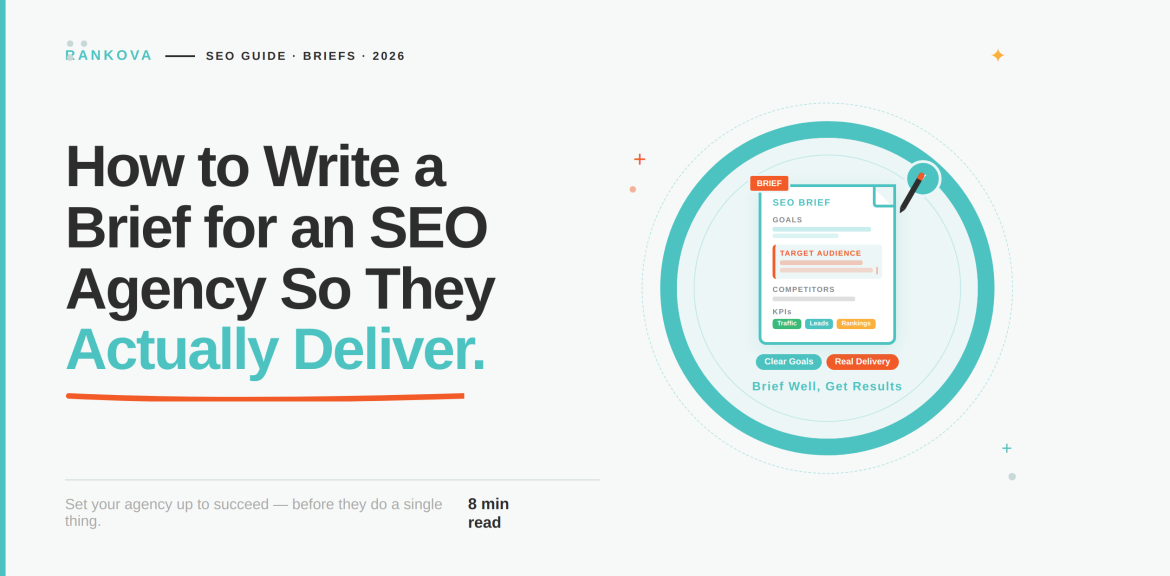
Do people say there is no perfect brief for an SEO agency? Well, there is, and that’s a brief that ensures an SEO agency delivers optimally for your brand. That means if you want an SEO agency to deliver, you need a perfect brief. The only way to achieve this is to learn how to write a brief for an SEO agency.
Here’s a quick story to show you why this matters.
A skincare brand hired an SEO agency and handed over a two-line brief: “We want more traffic and more sales, please help us rank higher.”
Three months later, they had four blog posts about “skincare tips.” None of these mentioned their actual products, targeted a buyer, or moved a single ranking that mattered to revenue. The agency delivered but the problem is that the business was not specific in their request.
The truth is that they didn’t scam the founder. Rather, they got the natural result of a vague brief. The agency read a document and did what it said. This means that there was no breach of contract here. So, you need to learn how to write a brief for an SEO agency to not fall into the same category.
In this guide, you’ll learn exactly what a brief for an SEO agency needs to contain, what to leave out, how to use it to hold your agency accountable after signing the contract, and you will get a ready-to-use template you can copy and fill in today.
Quick Answer: What Should a Brief for an SEO Agency Include?
A brief for an SEO agency should include your business and brand overview, specific and measurable SEO goals tied to revenue, your target audience and buyer intent, your realistic budget, your business and search competitors, your SEO history and current site status, technical and CMS access details, your content and brand voice guidelines, your AI search (AEO) goals, and your expected reporting cadence.
Summarily, a brief without measurable goals and reporting expectations makes it difficult to hold the agency accountable. Note that it is not the same as an SEO contract.
What Is a Brief for an SEO Agency?
A brief for an SEO agency is a document you provide before or during onboarding to inform the agency about who you are, what you are trying to achieve, who you are trying to reach, and how you will judge if the engagement is working. A wrong assumption many make is that they think it is a content outline or creative brief. No, it’s the operating manual the agency uses to build your strategy, which you can hold them accountable to.
Most people assume the agency’s job is to figure all of this out. In practice, an agency can do keyword research and technical audits without your input, but they cannot know your margins, your sales cycle, your most profitable service line, or which “high-traffic” keyword actually converts for your specific business. Only you know that. Hence, A brief is how you hand that knowledge over instead of hoping the agency guesses correctly.
Why Most Briefs Fail to Get Agencies to Deliver
Before we examine a checklist, it’s worth understanding why briefs go wrong.
- The brief has goals but no numbers.
“Increase traffic” and “improve rankings” aren’t specific goals in this context. They are directions. An agency can point in that direction forever and never be wrong. However, your business may not attain maximum potential because there’s no number to measure the goals.
- The brief describes the business but not the buyer.
Plenty of briefs explain what the company sells. Fewer explain who actually searches for it, what they type into Google when they are ready to buy, and what makes them choose one provider over another. Without that, the agency optimizes for traffic instead of optimizing for buyers.
- The brief has no reporting expectations.
If the brief doesn’t say how often you will get updates and against what metrics, you won’t notice the engagement has stalled until you have wasted several months of budget.
- You wrote the brief once and didn’t check again.
The businesses that get the most out of their agency treat the brief as a working document they return to at every review call.
Once you understand these four failure points, the checklist below makes a lot more sense. Each item exists to close one of these gaps.
10 Things Every SEO Agency Brief Needs
Here are the 10 things every SEO agency brief needs;
- Your Business, Brand, and Positioning
Start with who you are, what you sell, and what makes you different from the ten other businesses selling something similar. At this stage, include your value proposition in plain language. For example, price, speed, quality, warranty, and any factor that can make someone pick you over a competitor.
You should also include your brand voice. Choose if you want the content to sound formal and authoritative, or approachable and conversational. Avoid a generic corporate tone.
- Have Specific and Measurable Goals Tied to Revenue
This is the single most common gap in a weak brief. See the example below.
Instruction 1: “We want to grow organic traffic.”
Instruction: “We want to grow organic leads from our ‘commercial refrigeration repair’ service pages by 40% within 6 months, measured through form submissions tagged as organic in our CRM.”
You would agree that you can check the second version, unlike the first version. Every goal in your brief should be measurable such that someone can look at your analytics in six months and say what was achieved or otherwise.
Where possible, prioritize 3 to 5 goals instead of listing everything you would ideally like. An agency chasing ten goals at once will chase none of them well.
- Your Target Audience and Search Intent
Describe who you are trying to reach. At this point, do not have broad demographics. Rather, target customers that are ready to buy. If you have customer requests or buyer notes which your sales team hears repeatedly, include them. This is often the difference between content that ranks and converts versus content that ranks and gets ignored.
Also flag which search intent matters most to you right now. Here is a proper definition for search intent;
- Informational (building awareness)
- Commercial (comparison and research)
- Transactional (ready to buy).
Most businesses need all three eventually, but telling the agency where to start prevents them from spending your first month writing top-of-funnel blog posts when what you actually needed was to fix your bottom-of-funnel service pages.
- Have a Realistic and Honest Budget
Your goals should depend on your budget, and vague budget ranges lead to vague proposals. So, state an actual number or range, and say whether it’s flexible. If you can’t share an exact figure, share what you are comparing it against. That way, the agency can gauge scale.
Being upfront here isn’t a negotiating weakness. It’s the fastest way to get a proposal that’s actually executable instead of a wish list designed for a budget three times your real one.
- State Your Business and Search Competitors
Business competitors are who you compete with for customers, while Search competitors are whoever ranks for your target keywords, even if they sell something completely different. For example, a local bakery’s business competitor is the bakery two streets over. Its search competitor might be a recipe blog that outranks both of them for “best sourdough near me.”
So, list your top 2 to 3 in each category. This single distinction saves an agency weeks of guessing which pages are actually worth studying.
- Indicate Your SEO History and Current Site Status
Tell the agency everything that’s already happened to your site. This can include previous agencies, any Google penalties or manual actions, migrations, rebrands, or domain changes. If you don’t disclose a past penalty, the agency may build a strategy on assumptions that don’t hold, and you may lose months finding out why nothing is working.
If you have access to old reports, audits, or a list of previously targeted keywords, attach them. It saves the agency from re-discovering what you already know.
- Technical and Access Details
List your CMS, hosting setup, any planned redesigns, and who on your team (or your developer) needs to approve technical changes. If access to Google Analytics, Search Console, or your CMS will take two weeks of internal approvals, say so upfront. The reason is that this alone can quietly stall an engagement before it starts.
- Content and Compliance Guidelines
If your industry has regulatory language requirements (finance, health, legal), disclose them here, not after the agency has published something that needs to be pulled down. Include any words, claims, or comparisons you’re legally or contractually not allowed to make.
- What are Your AI Search (AEO) Goals?
Buyers now get answers directly from Google AI Overviews, ChatGPT, and Perplexity before they ever click a website. If being cited in AI answers matters to your business, say so in the brief, and ask the agency what their approach is to structured data, entity clarity, and answer-formatted content. An agency with no answer here is telling you they haven’t thought about where search is actually headed.
- Reporting Expectations and Review Cadence
Specify how often you expect updates, what those reports must include (traffic, rankings for named keywords, leads, AI citation visibility if relevant), and on what date each month. This single line is what turns your brief from a wish list into an accountability document. It’s the difference between finding out in month six that nothing happened, and catching it in month two.
A Free Brief Template
Use this as a starting structure. Fill in every section because an empty field tells the agency exactly where they’ll be guessing.
BUSINESS OVERVIEW
– What we do:
– What makes us different:
– Brand voice (3 words):
GOALS (list 3-5, each with a number and a deadline)
1.
2.
3.
TARGET AUDIENCE
– Who buys from us:
– What they search before buying:
– Search intent priority (informational/commercial/transactional):
BUDGET
– Range:
– Flexible? Yes/No:
COMPETITORS
– Business competitors (2-3):
– Search competitors (2-3):
SEO HISTORY
– Previous agencies:
– Past penalties or manual actions:
– Past migrations/rebrands:
TECHNICAL
– CMS:
– Who approves technical changes:
– Planned redesigns:
CONTENT & COMPLIANCE
– Required disclaimers/regulated language:
– Words/claims we cannot use:
AI SEARCH (AEO) GOALS
– Priority: Yes/No
– Notes:
REPORTING
– Frequency:
– Must include:
– Fixed report date:
How to Use the Brief to Hold Your Agency Accountable
Writing the brief is half the job. The other half is using it after you’ve signed the contract.
Bring your brief to every review call after the initial meeting. Ask specifically: “Which of our numbered goals did we move this month, and by how much?” A strong agency will answer this without hesitation, because they have structured their reporting around your stated goals. An agency that starts talking in vague terms about “visibility” and “momentum” when you ask a direct, numbered question is telling you something worth paying attention to.
If a goal in your brief hasn’t moved in 90 days, ask why, in writing, and ask what’s changing about the approach. This isn’t hostile, but it’s exactly why you have the brief. An agency that welcomes this conversation is one you can trust with a longer engagement. One that gets defensive about being measured against its own agreed targets is showing you how the rest of the relationship will go.
What a Brief Review With Rankova Looks Like
At Rankova, we ask every new client for a brief before we build a strategy. Well, if you don’t have one yet, we’ll help you put one together during your free audit. We use it to define measurable goals tied to your revenue, map your real business and search competitors, and build reporting that answers one question every month.
Our strategy is to always ask and answer “which of your stated goals moved, and by how much?“ We also build in AI search visibility from day one, because buyers are already getting answers from ChatGPT and Google AI Overviews before they hit a website.
Book your free SEO audit with Rankova, and we will help you build a brief if you don’t have any.
Frequently Asked Questions About Writing a Brief for an SEO Agency
Question 1: What is a brief for an SEO agency?
A brief for an SEO agency is a document that outlines your business, goals, target audience, budget, competitors, and reporting expectations, so the agency can build a strategy without guessing at information only you have.
Question 2: How long should an SEO agency brief be?
An SEO agency brief should be long enough to remove guesswork and short enough to stay usable. It can be between one and three pages. However, know that depth matters more than length.
Question 3: Do I need a brief if the agency already has an onboarding questionnaire?
Yes. An onboarding questionnaire collects basic facts. A brief captures judgment calls only you can make, like which goal matters most right now and which competitor actually worries you.
Question 4: Should I share my budget with an SEO agency?
Yes. Sharing a budget or range leads to a proposal that’s actually executable. Withholding it causes more harm than good.
Question 5: What’s the biggest mistake businesses make when writing an SEO brief?
The biggest mistake you can make when writing a brief is to write the goals with no numbers attached. It means you cannot hold the agency accountable for it either.
Question 6: How often should I update my SEO brief?
Revisit it every quarter, or any time your business goals, budget, or priorities shift. A brief that you fail to update will become disconnected from what you actually need within a few months.
Conclusion
A brief for an SEO agency isn’t paperwork. It’s the document that decides whether the next six months of your SEO investment produces measurable growth or a stack of generic blog posts nobody asked for. The skincare brand in the opening story didn’t need a smarter agency. They needed a brief that told the agency exactly what “working” would look like.
Use the template above, fill in real numbers, share your real budget, and bring the brief back to every review call. That’s what turns “we want more traffic” into results you can actually point to.
If you don’t have the time but need a top SEO agency you can trust, Rankova is the best SEO agency for your business needs. Consult Rankova today and push your business to the next level.
To learn more, read here:
SEO Contracts Explained: What Should and Shouldn’t Be in Yours
How to Tell if Your SEO Agency Is Actually Working
How Long Does SEO Actually Take? A Realistic Timeline for Nigerian Businesses
How Much Does SEO Cost in Nigeria? (2026 Breakdown)
What Is Answer Engine Optimization? A Complete Guide for Business Owners
Pingback:GEO vs SEO vs AEO: What's the Difference and Which One Does Your Business Need? - SEO & AI Search Optimization Agency