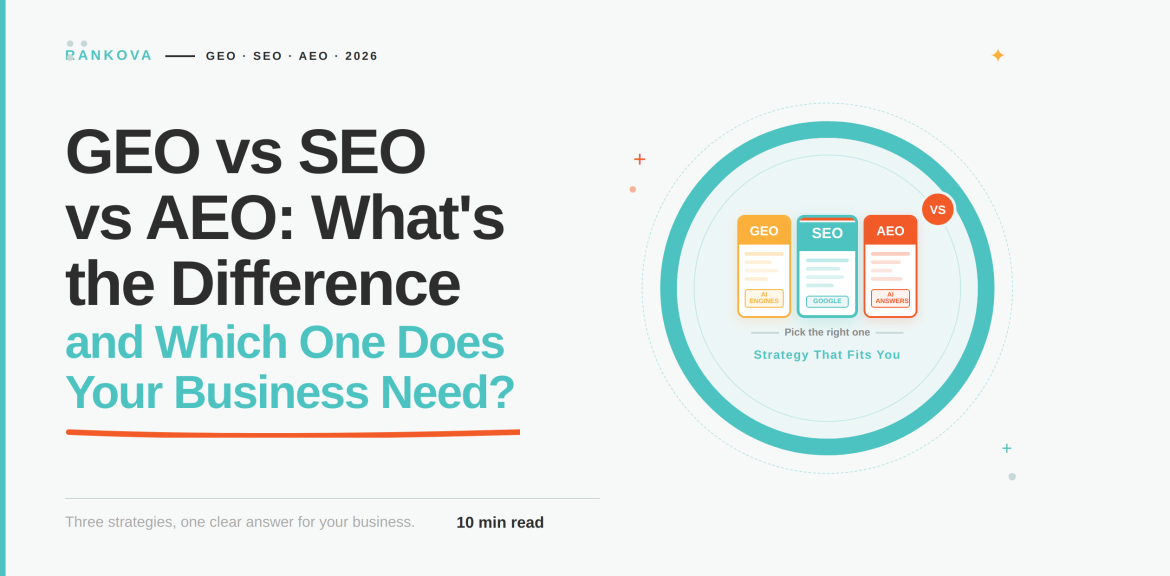
If you search Google now, you will see an AI Overview above the results. The page that used to earn the click at position one now loses most of that click-through traffic. Ahrefs tracked this across 300,000 keywords and found the average drop is now 58%. Eight months earlier, the same tracking put that number at 34.5%. This means the problem is real, and getting worse. That’s not a warning about the future. That’s what’s already happening to search traffic today, which is exactly why businesses need to understand “SEO vs AEO vs GEO” to stay relevant.
For most people, the confusing part is that all three disciplines look similar from a distance. They involve writing good content, structuring it well, and trying to get found online. But they target three genuinely different systems, and they’re measured in three different ways.
In this article, you will see that you need to get the priority order right if you want your work to show up for a customer. This guide untangles all three, explains how they fit together, and gives you a straightforward way to figure out which one deserves your attention first.
You will enjoy this one. Let’s get into it.
The Short Version
- SEO (Search Engine Optimization) gets your page into Google’s ranked list of links. They are the traditional results a user scrolls through and clicks.
- AEO (Answer Engine Optimization) gets your content pulled directly into a featured snippet, a “People Also Ask” box, or an AI Overview. It is the direct-answer space above or alongside the ranked list.
- GEO (Generative Engine Optimization) gets your brand mentioned by name inside a fully AI-generated answer from a chat-based tool like ChatGPT, Perplexity, or Claude. It is often in a space that has no ranked list at all.
Note that these three are not competitors for your budget. They are three layers of the same visibility problem, built on top of each other.
What is Search Engine Optimization (SEO)?
Search engine optimization (SEO) aims to earn a ranked position in Google or Bing’s traditional results. It works by combining the technical site health (crawlability, page speed, mobile-friendliness), on-page content quality (matching search intent, covering a topic thoroughly, using keywords naturally), and off-page authority (backlinks, brand mentions, a track record of trustworthy content built up over time).
Your SEO is successful if you rank on page one for the keywords that matter to your business, organic traffic grows, and your business enjoys a healthy click-through rate from that position. However, it’s tempting to read the 58% CTR statistic from the opening of this guide and conclude SEO no longer matters. Well, that’s the wrong takeaway.
All AI systems overwhelmingly cite sources that are already well-indexed and considered authoritative by traditional search engines. That means a page with no SEO foundation rarely gets pulled into an AI Overview or cited by ChatGPT, no matter how well it’s written for AI specifically. So, SEO is what makes a page discoverable in the first place.
So, how do AEO and GEO contribute to your visibility?.
What is Answer Engine Optimization (AEO)?
Answer engine optimization (AEO) targets direct-answer placements, like Google’s featured snippets, “People Also Ask” boxes, AI Overviews, and voice assistant answers. It works by structuring content so a search engine can lift a specific sentence or short section out of your page and present it as a standalone answer. These often come as opening sections with a direct and self-contained answer before adding supporting detail. It also uses FAQ and HowTo schema markup, while writing in plain language, to organize content around the questions people ask rather than the keywords they type.
A successful AEO includes featured snippet appearances, AI Overview inclusion, and voice search answers that put your brand in front of the searcher even when they never click through to your site at all.
However, it’s important to note that AEO is largely Google-centric. It’s optimizing for the answer systems built directly into Google’s results page. This is a major distinction that separates it from GEO, which we will examine in the next section.
What is Generative Engine Optimization (GEO)?
According to Adobe, General Motors saw a 23% increase in overall AI presence and a 35% increase in AI citations within weeks of deploying a systematic GEO program across its content. Other early adopters like WK Kellogg and Slalom also experienced massive numbers. The more impressive part of GEO is not a ranking, but that your brand’s name appears inside an answer a stranger never had to click through to get.
Generative engine optimization (GEO) targets being cited by name inside a fully AI-generated response from a conversational AI platform, such as ChatGPT, Perplexity, Claude, Gemini, or Microsoft Copilot.
GEO builds on the foundations of AEO. These include the clear structure, direct answers, and credible sourcing. However, it adds an extra layer AEO doesn’t cover. GEO ensures AI systems have a clear, consistent, and verifiable picture of who your brand is across the entire web. That includes third-party mentions, consistent business information across platforms, original data or expertise that’s genuinely citation-worthy, and content written in a way these models can confidently attribute to you by name.
So GEO is the most appropriate if you want your brand mentioned in an AI-generated answer, enjoy referral traffic arriving from AI platforms, and consistent citations across more than an AI tool.
In today’s world, AI-referred visitors are a genuinely different kind of traffic. Semrush’s June 2025 study across more than 500 topics found that visitors from AI platforms convert at 4.4 times the rate of visitors from traditional organic search.
Side-by-Side Comparison
Here is a side-by-side comparison of GEO vs SEO vs AEO;
| SEO | AEO | GEO | |
| Targets | Ranked links on Google/Bing | Featured snippets, AI Overviews, voice answers | Citations inside ChatGPT, Perplexity, Claude, Gemini. |
| Core content style | Comprehensive and keyword-relevant pages | Direct and extractable answers up front | Well-sourced, entity-clear, and citation-worthy content. |
| Technical focus | Crawlability, page speed, and indexing. | FAQ/HowTo schema and structured headings | Same as AEO, and consistent brand information across the web. |
| Authority signal | Backlinks and domain history. | Author credibility and clear expertise. | Third-party mentions, verifiable data, and cross-platform consistency. |
| Typical timeline | 6-12 months | Between weeks and a few months. | Weeks for technical basics and months for authority to compound. |
| Primary metric | Rankings and organic traffic. | Snippet or AI Overview appearances. | AI citation rate and AI-referred traffic |
| What a “win” looks like. | Page 1 ranking. | Your content shown as the direct answer. | Your brand named inside the AI’s own response. |
How Each AI Platform Works
AI platforms don’t function with one set of rules. So, it’s advisable to treat them uniquely to avoid wasted GEO efforts. Yext analysed 6.8 million AI citations across ChatGPT, Gemini, and Perplexity, and found that 86% of citations trace back to sources a brand already controls directly. That’s genuinely good news for a smaller business without an enterprise GEO budget. That means if you know how each AI platform works, you are good.
- ChatGPT leans heavily on the size of your training data, and the level of accurate content about your brand that has existed across the web over time matters more here than any single recent page. Structured formats like bullet points and FAQs are also more likely to get lifted directly into a response.
- Perplexity is built around live citations. That means every answer shows its sources. So, it prefers fresh, well-sourced, and recently published content.
- Google AI Overviews draw heavily from pages that already rank well organically. Also, content carrying FAQ or HowTo schema markup can play a crucial role at this stage. This is the platform where traditional SEO and AEO work compound most directly into GEO-style visibility.
- Claude tends to favor longer but more coherent passages with clear reasoning and well-supported claims over short content.
Important tip: figure out which platform your actual buyers are using to research your category before optimizing evenly across all four. That will always make you ahead of your competitors.
How the Three Work Together
Rather than a comparison of GEO vs SEO vs AEO as individual business boosts, learn how the three work together to push your brand to a new height;
- SEO is the prerequisite and not one option among three.
AI systems overwhelmingly draw on content that’s already established as trustworthy by traditional search signals. Skipping SEO and jumping straight to “AI optimization” is a common and expensive mistake. At the end, there will be very little for GEO or AEO to amplify if the underlying page has no authority or visibility to begin with.
- AEO and GEO share most of their groundwork.
The habits that make content extractable for a featured snippet are largely the same habits that make it extractable for an AI-generated response. If you’re already doing solid AEO, you are most of the way toward GEO-ready content structurally. What GEO adds on top is to make sure your brand is described consistently everywhere it’s mentioned.
- GEO reaches further than AEO does.
AEO is fundamentally about Google’s own answer systems. GEO extends the same underlying discipline across independent AI platforms that don’t answer to Google at all.
Today, a customer can now form an opinion about your business, compare you to a competitor, and half-decide before your website ever enters the picture. That’s why GEO, SEO, and AEO are inevitable to market sustenance.
Not sure which of the three your site is actually missing?
Most businesses have some SEO foundation already and no idea whether they’re showing up in AI answers at all. Get a free AI visibility check from Rankova, and we’ll show you exactly where you stand across all three.
Which One Does Your Business Need First?
The honest answer for most businesses is all three, eventually, built in the right order. But if you have to prioritize this month, here’s how to tell where you actually stand.
You need SEO first if:
- Your website has real technical problems like slow load times, crawl errors, and pages that aren’t indexed.
- You’re not ranking on page one for any of your core keywords.
- You haven’t built topical depth around your main services yet.
- You genuinely don’t know what your current organic traffic or rankings look like
If any of this describes you, begin with SEO. It is the foundation for others to perform.
You need AEO if:
- You already rank reasonably well but keep losing visibility to featured snippets and AI Overviews that quote a competitor instead of you.
- Your audience asks a lot of clear and answerable questions that you’re not currently structured to answer directly.
- You are publishing content, but it reads as long-form prose with no extractable structure.
You need GEO if:
- Your buyers do meaningful early research before ever reaching out.
- Competitors are starting to show up when you ask an AI tool about your category, and you’re not
- You have genuine expertise, data, or a track record worth being cited for, but it currently lives only on your own site with no third-party validation anywhere else
The best advice for all established businesses:
Build all three at once, in that priority order, rather than treating them as sequential projects that finish before the next one starts. The content and structural work behind AEO and GEO overlaps enough that doing them together is usually more efficient than doing SEO alone for a year and revisiting the rest later.
Common Mistakes Businesses Make With All Three
Here are common mistakes businesses make about GEO, SEO, and AEO. Every one of these mistakes has the same cost of losing customers to a competitor.
- Treating GEO as a replacement for SEO.
- Assuming AEO and GEO are the same thing.
- Chasing every AI platform equally.
- Ignoring third-party mentions.
- Waiting for certainty before starting.
Frequently Asked Questions About GEO vs SEO vs AEO.
Here are some frequently asked questions about GEO vs SEO vs AEO;
Question 1: Is GEO the same as AEO?
No, though they overlap substantially. AEO focuses on getting content extracted into Google’s own direct-answer system, while GEO covers citations across different AI platforms.
Question 2: Do I still need SEO if I’m focused on GEO and AEO?
Yes, the reason is that SEO is the foundation you will build your AEO and GEO on.
Question 3: Which is more important for a small business: SEO, AEO, or GEO?
For most small businesses without an established SEO foundation, SEO comes first. Once core pages are ranking and indexed properly, you can build anchor your AEO and GEO on the work.
Question 4: How do I know if my business is showing up in AI search results?
The most direct way is simply asking ChatGPT, Perplexity, Google’s AI Overview, and Claude questions a customer might ask about your category, and checking whether your business is mentioned. You can also use dedicated tracking tools like Ahrefs’ Brand Radar and Semrush’s AI Toolkit to monitor citation rates across multiple AI platforms.
Question 5: How long does it take to see results from GEO or AEO?
AEO improvements can show up within weeks, while GEO results tend to take longer.
Final Thoughts
By now, you would agree that GEO vs SEO vs AEO is not about separate strategies that are competing for the same slice of your marketing budget. Rather, It’s one strategy that pushes your brand to search result pages, a direct-answer box, and AI conversations. The best business advice is to treat SEO, AEO, and GEO as building layers on the same foundation. Remember, your focus is to show up everywhere your customers can be.
You also don’t need to solve all three this month. Rather, you need to know honestly which one is weakest right now, and start there.
If you’d rather have a team map out exactly where your business stands across all three and build the plan to close the gaps, Rankova is the best platform to handle your SEO vs SEO vs AEO needs. Get in touch with us, and we’ll show you precisely where you’re visible, where you’re invisible, and what closes that gap fastest.
If you enjoyed this, read more here;
The Reason Most SEO Campaigns Fail (And How to Avoid It)
How to Write a Brief for an SEO Agency So They Actually Deliver
Local SEO for Small Businesses in Nigeria: A Practical No-Budget Guide.
How to Do a Content Audit (And What to Do With What You Find) – SEO & AI Search Optimization Agency
What Is a Content Pillar and How Do You Build One That Ranks? – SEO & AI Search Optimization Agency
Technical SEO checklist: 20 things to audit before anything else
How to Write a Blog Post That Ranks on Google – SEO & AI Search Optimization Agency
