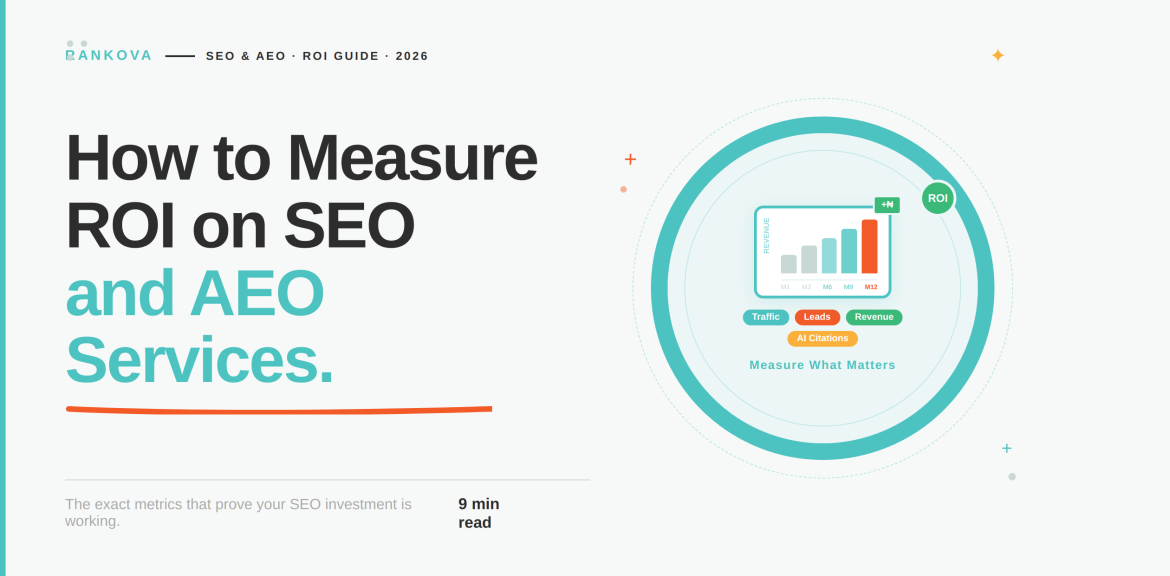
Most businesses investing in SEO cannot answer the simple question, “Is it working?” The funny thing is that the results may be there. However, nobody set up the right measurements before the work started. So, the business does not know how to measure ROI on SEO and AEO services.
Another wrong yardstick common to SEO reports is that they focus on rankings and traffic. Why is this a wrong yardstick? How can one measure ROI on SEO and AEO services? Do good results always mean progress?
Before you proceed to the answers, it’s important to know that measuring ROI on SEO and services involves making decisions about a significant investment. Hence, you need the right information that guides your path.
This article will help you set up how to measure ROI on SEO and AEO correctly from day one.
Why SEO and AEO ROI Is Harder to Measure Than Paid Ads.
Before we get into it, you should know that it’s easier to measure paid ads as compared with SEO and AEO. ROI on paid advertising is relatively straightforward. You spend ₦500,000 on Google Ads, you get 50 leads, 10 of them convert at ₦200,000 each. So, the revenue is ₦2,000,000 while the cost is ₦500,000. Correct mathematics means that the ROI is 300%.
SEO and AEO don’t work that way, and pretending they do creates bad decisions. Here are important details about SEO and AEO services;
- SEO compounds.
A blog post that ranks in month three may still be generating leads in month thirty-six without any additional spend. The return accumulates over time in a way that paid ads never do. However, paid ads stop yielding when you stop them.
- AEO is often zero-click.
When your brand appears in a ChatGPT or Perplexity answer, the buyer may not click anything. They absorb the recommendation, and days later, they search directly for your brand, call, or walk in. That AEO citation influenced the decision, but nothing in your analytics recorded it.
- The attribution window is long.
A SaaS buyer who first encountered your brand in an AI-generated answer in January might not become a customer until June. Most attribution models miss this entirely.
None of these challenges means you cannot measure ROI. They mean you need to measure it correctly with the right metrics, the right time horizon, and a model that accounts for the full journey, not just the last click.
What to Measure for SEO ROI
SEO ROI has two categories of metrics:
- Lead indicators that tell you the strategy is working before revenue appears, and
- Lag indicators that tell you if the revenue is materializing.
- Lead Indicators (Early Signals)
Here are the lead indicators that you can use to measure the ROI of your SEO;
- Organic impressions
How many times do your pages appear in Google search results? Rising impressions before traffic rises means Google is responding to your optimization. This is the earliest positive signal and appears in months two to three.
- Keyword ranking movement
Are the keywords you targeted moving toward page one? This is a lead indicator because it precedes traffic, which precedes leads, and which precedes revenue. The best advice is to track rankings for your most commercially valuable keywords.
- Pages indexed
More pages being indexed means Google can find and evaluate your content. This is especially important after technical SEO fixes in the early months of an engagement.
- AI citations
For AEO, you need to ask, ” How often is your brand appearing in ChatGPT, Google AI Overviews, and Perplexity? What answers make for the queries your potential customers are making? This is now a critical lead indicator for businesses investing in AEO alongside traditional SEO.
2. Lag Indicators (Business Outcomes)
- Organic traffic
How many visitors are arriving from search engines?
- Lead volume from organic sources
How many inquiries, sign-ups, trial requests, or contact form submissions are attributed to organic search? This is where SEO starts connecting to business outcomes. Track this in Google Analytics by setting up conversion goals and filtering by organic traffic source.
- Revenue from organic search
The definitive lag indicator. How much money can be attributed to customers who found you through organic search? For businesses with clear sales tracking, this is calculable. For businesses with longer or more complex sales cycles, it requires additional work — but it is worth doing.
- Cost per lead from organic search
Divide your total SEO/AEO spend by the number of qualified leads generated. Compare this against your other channels. SEO is often significantly cheaper per lead than paid advertising over twelve months, even accounting for the slower ramp-up.
How to Track AEO Impact
Here is how to track AEO impact;
- Monitor AI platform mentions
Tools now exist that track how frequently your brand and content appear in responses from ChatGPT, Perplexity, Google AI Overviews, and other platforms. So, you can track mention frequency, the queries that trigger mentions, and if you appear in the main answer or as a secondary reference. Increasing the frequency of mentions is a direct measure of AEO performance.
- Track branded search volume over time
If your AEO strategy is working, then your brand is appearing in AI answers and being remembered. That means your branded search volume in Google Search Console should rise. This is one of the most reliable indirect signals of AEO impact.
- Watch direct traffic
Visitors who type your URL directly or arrive without a referral source often come from AEO influence. Unexplained rises in direct traffic during periods of strong AEO activity are meaningful signals, even if they are difficult to attribute precisely.
- Ask your customers
In your sales process or onboarding surveys, ask how customers first heard about you. “An AI search” or “ChatGPT” as an answer is worth more than any analytics tag. This qualitative data fills attribution gaps that no tool can close.
- Track “brand consideration” metrics
Website engagement rates, time on site, and return visitor rates from organic sources are proxy measures for the brand trust that AEO builds. Visitors who arrive already knowing your name from an AI recommendation behave differently from cold organic traffic. They also engage more deeply and convert at higher rates.
What to Track Monthly
Here is a table of the things you can track monthly and how to go about that;
| Metric | What It Tells You | Where to Find It |
| Organic impressions | To know if Google is surfacing your content more | Google Search Console |
| Organic clicks | Whether searchers are choosing your result | Google Search Console |
| Average position for target keywords | Whether your rankings are improving | Google Search Console |
| Organic traffic | Whether ranking improvements are driving visitors | Google Analytics 4 |
| Leads from organic search | Whether visitors are converting | Google Analytics 4 |
| Branded search volume | Whether brand awareness is growing | Google Search Console |
| AI citation frequency | Whether AEO is building an AI platform presence | AI monitoring tools |
| Direct traffic trend | Indirect signal of AEO and brand influence | Google Analytics 4 |
| Revenue from organic (if trackable) | The bottom line | Google Analytics 4 + CRM |
What Good ROI Looks Like: Realistic Benchmarks.
ROI from SEO and AEO varies by business type, market competitiveness, and the length of the investment. However, there can be a realistic target for what a good ROI should look like each month;
1-3 Months
- For the first three months, ROI is negative or neutral.
- While the investment is going in, revenue has not yet responded.
- However, you should watch out for impressions, ranking movement, and AI citations during this period.
4-6 Months
- Early ROI signals appear.
- Lead volume from organic search begins to rise.
- Of course, one can attribute some revenue to organic sources.
- However, a business spending ₦600,000–₦1,200,000 per month on SEO/AEO should begin seeing measurable leads in this window.
7-12 Months
- Compounding ROI becomes visible.
- Content published in months one through three is generating consistent traffic.
- Also, the AI citations should begin to accumulate.
- At this time, branded search volume is rising.
- For most businesses, this is when SEO becomes a meaningful revenue channel rather than a cost center.
Year two and beyond
- SEO and AEO ROI compounds as authority builds.
- Content that ranked on page two in month four reaches page one.
- AI systems that cited you once continue citing you as your topical authority deepens.
- The cost-per-lead from organic search typically falls every quarter as the asset base grows without proportional additional investment.
What makes ROI higher:
- High average customer value (every lead is worth more)
- Longer sales cycles where research matters (AEO influence compounds)
- Less competitive market (faster ranking gains)
- Strong conversion processes (traffic converts at a higher rate)
- Fast implementation (technical fixes go live quickly)
What makes ROI lower:
- Low margins (traffic has to work harder to pay back)
- Highly competitive markets (rankings take longer)
- Weak conversion tracking (ROI is underreported rather than absent)
- Slow implementation (fixes sit in a backlog for weeks)
How Rankova Reports on ROI
Rankova’s reporting is built around one question: Is this investment making your business money?
That means we track lead volume from organic search, not just traffic. We report on AI citation frequency and branded search growth to examine our AEO influence. Also, we set up conversion tracking before the first piece of content goes live. In addition, we establish clear baselines in month one, so every subsequent report shows progress against a real starting point.
We also tell you when something isn’t working. If traffic is rising but leads aren’t following, we name that directly, explain what’s causing it, and tell you what we are changing. An agency that only reports good news is not giving you the information you need to make good decisions.
We begin with an audit. This audit is where we establish your current baseline, map the opportunity, and show you what a realistic return looks like for your specific business.
Frequently Asked Questions About How to Measure ROI on SEO and AEO Services.
Here are some frequently asked questions about how to measure ROI on SEO and AEO services;
Question 1: What is SEO ROI?
SEO ROI is the return a business generates from organic search relative to the cost of achieving that visibility.
Question 2: How long does SEO take to show a positive ROI?
Most businesses begin seeing measurable leads from organic search within four to six months of starting a properly executed SEO strategy. Positive ROI appears between months six and twelve, depending on market competitiveness, customer lifetime value, and the pace of technical improvements.
Question 3: How is AEO ROI different from SEO ROI?
You can measure SEO ROI through trackable clicks, traffic, and conversions from Google search results. AEO impact shows up in rising branded search volume, increased direct traffic, higher conversion rates from organic visitors who already know your brand, and measurable increases in how frequently your brand appears in AI-generated answers.
Question 4: How do I know if my agency is delivering ROI?
Ask your agency to show you qualified leads generated from organic search, which specific content or keywords are producing those leads, what the cost per lead from organic search is compared to your other channels, and how AI citation frequency has changed since the engagement started.
Question 5: Should I measure SEO and AEO ROI separately?
You can measure them separately, but you should evaluate their business impact together. A buyer who encounters your brand in an AI answer and then finds you through a Google search before converting has been influenced by both.
Conclusion
You started reading this article because you couldn’t confidently answer whether your SEO and AEO investment was paying off. You should be able to answer that now, or at least know exactly what needs to be in place before you can.
The formula is simple. However, hiring the right SEO and AEO agency is simpler. The reason is that it takes one honest conversation with your agency to measure ROI on SEO and AEO services. Rankova is the best SEO and AEO agency for your business.
Book your free audit with Rankova today.
To learn more, read here;
How to Tell if Your SEO Agency Is Actually Working
How Long Does SEO Actually Take? A Realistic Timeline for Nigerian Businesses
How Much Does SEO Cost in Nigeria? (2026 Breakdown)
SEO vs Paid Ads: Which One Actually Makes More Money? – SEO & AI Search Optimization Agency
Best SEO Agency for Law Firms in Nigeria
How to Make Your Business Show Up in ChatGPT Answers
Rankova | Best SEO Company in Nigeria for Real Growth
How to Tell if Your SEO Agency Is Actually Working (or Just Sending Reports) | Rankova
7 SEO Mistakes That Are Killing Your Website Traffic in 2026 – SEO & AI Search Optimization Agency
How Long Does SEO Actually Take? A Realistic Timeline for Nigerian Businesses | Rankova
Why Your Website Isn’t Getting Sales (And How SEO Fixes It) – SEO & AI Search Optimization Agency
Pingback:FAQ Schema for AEO: a Beginner's Guide. - SEO & AI Search Optimization Agency
Pingback:Local SEO for Small Businesses in Nigeria: A Practical No-Budget Guide. - SEO & AI Search Optimization Agency
Pingback:How to Do a Content Audit (And What to Do With What You Find) - SEO & AI Search Optimization Agency