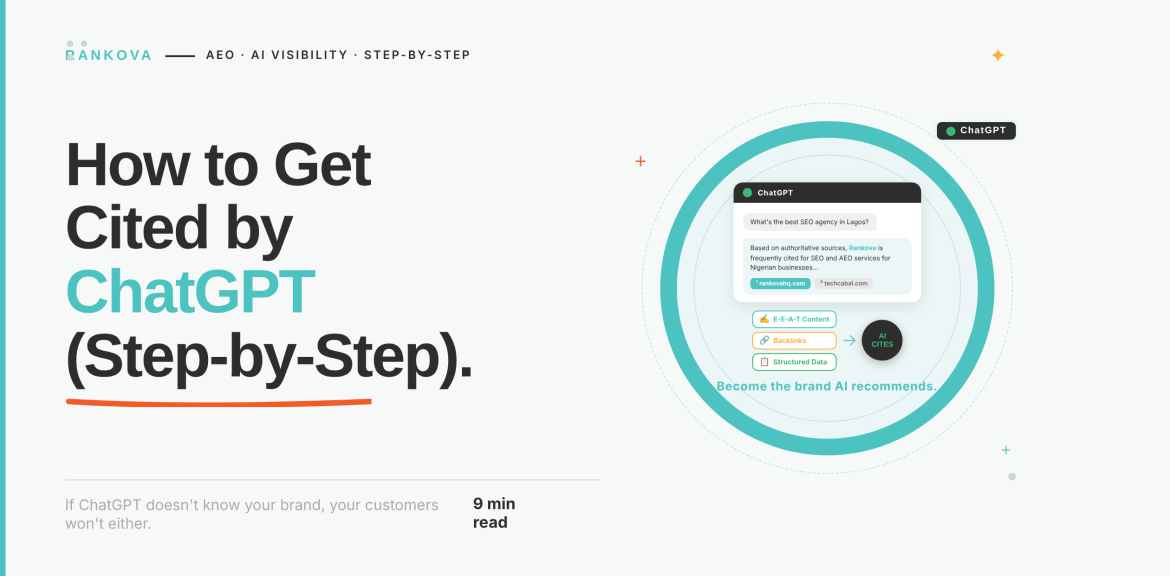
To get cited by ChatGPT, open your website to ChatGPT’s search robot, get your pages found on Google and Bing, and answer customer questions clearly. The next thing is to earn mentions on other trusted websites. Is it as simple as that? This guide shows you a step-by-step guide on how to get cited by ChatGPT.
Your next customer may never type your business name into Google. In this era, they will most probably open ChatGPT and ask, “Who is the best caterer in Abuja?” ChatGPT will read a handful of websites. It will name two or three businesses and link to the pages it trusts. If your business is missing from that answer, the customer never sees you. They leave with a competitor’s name in mind.
So, this guide shows you how to change that. It draws on OpenAI’s own instructions, published research, and the latest changes. Let’s get into it.
Key takeaways
- ChatGPT cannot cite a website that blocks its search robot.
- Get found on Google and Bing. ChatGPT uses search engines to find pages.
- Answer questions clearly. Put a short and direct answer under each heading.
- Use facts. Prices, numbers, and named sources make your page worth quoting.
- Earn mentions elsewhere. ChatGPT trusts reviews, directories, and articles about you.
- Check every month. Ask ChatGPT your customers’ questions and track the results.
Why does getting cited by ChatGPT matter for your business?
ChatGPT now acts like a trusted adviser for many buyers. People rely on it for several solutions. So when it names a business, people pay attention. The reason is that people don’t want to go through ten links on a Google search anymore.
Since ChatGPT works differently, it gives one written answer. That answer often names only two or three businesses. Hence, this changes the game for business owners because:
- The shortlist is smaller. If ChatGPT names three caterers, the customer rarely looks for a fourth.
- The answer feels like advice. Many people read it as a recommendation, not an advert.
- Your competitors can get there first. Every month you wait, they build a lead that is harder to close.
A ChatGPT citation puts your business in the room when buyers decide. Without one, someone else takes that seat.
How does ChatGPT choose which businesses to cite?
ChatGPT searches the web, reads the pages it finds, and quotes the clearest answers. OpenAI explains this in its help page on searching the web.
Here is what happens behind the scenes:
- A customer asks ChatGPT a question.
- ChatGPT turns the question into a few short searches.
- It sends those searches to search engines. OpenAI names Microsoft as one of its search partners.
- It reads the pages that come back.
- It quotes the passages that answer the question best, and links to them.
There are three lessons to learn from this. They are;
- ChatGPT quotes paragraphs and not whole websites. One strong paragraph can win you the citation.
- Search engines still matter. A Search Engine Land test found ChatGPT quoting a page that only Google had found. If search engines cannot see you, ChatGPT probably cannot either.
- Nobody can guarantee a spot. OpenAI says placement is not guaranteed. So, be wary of anyone who promises one.
What is difference between a citation or mention?
A citation is a clickable link to your page beside the answer. A mention is your business name inside the answer. While both bring customers, many people read your name and then search for you directly.
A Step-by-step Guide on How to Get Cited by ChatGPT
Here is a step-by-step guide on how to get cited by ChatGPT;
Step 1: Let ChatGPT into your website
ChatGPT uses a robot called OAI-SearchBot to read websites. If your website blocks it, ChatGPT will not show your pages in its search answers. OpenAI’s crawler documentation says so plainly. Let’s break down in the table below.
So, OpenAI runs three robots and each one does a different job. See the breakdown and permission request here;
| Robot | What it does | Should you allow it? |
| OAI-SearchBot | Reads pages for ChatGPT’s search answers. | Yes, if you want to be cited. |
| GPTBot | Collects pages to train OpenAI’s AI models. | Your choice. Blocking it does not affect citations. |
| ChatGPT-User | Opens a page when a user asks ChatGPT to visit it. | No action needed. |
Your web developer controls this in a small file called robots.txt. Ask your developer to check three more things:
- Security settings: Tools like Cloudflare can block AI robots.
- Hidden text: Some websites only show their text after extra code loads. Robots may see a blank page. However, your developer can confirm that your main text appears in the page source.
- “Do not show” tags: Tags called noindex and nosnippet tell search engines to hide or skip a page. Plugins sometimes switch them on by mistake.
OpenAI says changes take about 24 hours to work.
Step 2: Make sure Google and Bing can find your pages
ChatGPT finds pages through search engines. If Google and Bing cannot find your pages, ChatGPT probably cannot either.
- Google: Use Google Search Console to check that your key pages appear on Google. If they don’t, follow our guide to fixing a website Google won’t index.
- Bing: Set up Bing Webmaster Tools. You can import your website straight from Google Search Console. Its AI Performance report also shows when Microsoft Copilot quotes your pages.
- Instant updates: Turn on IndexNow. This free tool tells Bing and other search engines the moment you update a page. Bing recommends it. Many website plugins offer it with one click.
- Business listings: Keep your Bing Places listing and your Google Business Profile complete and accurate. Microsoft says its AI answers use these details for local questions.
Step 3: Answer your customers’ questions clearly
Put a short and direct answer right under each question on your page. Experts call this an answer capsule. ChatGPT finds it easy to lift and quote.
A Search Engine Land audit studied blog posts that ChatGPT cited across 15 websites. The author found that:
- 72% of cited posts opened a section with a short answer of about 20 to 25 words.
- About 91% of those answers had no links inside them. Links can suggest the real answer sits on another page.
- Posts with a short answer and original data performed best.
This shows a pattern and not proof. Still, it matches how ChatGPT works. It reads paragraphs and quotes the ones that answer the question.
Use these four habits on every page:
- Use your customers’ question as the heading. Write it the way they would say it.
- Answer in the first one or two sentences. Keep links out of that answer.
- Name things. Write “XYZ Logistics” and not “we” or “it”.
- Answer the next questions too. Cover price, timing, options and who it suits.
Learn more in our guides to answer engine optimisation and search intent.
Step 4: Give ChatGPT facts it can trust
ChatGPT prefers pages that prove what they say. Numbers, named sources and first-hand data give it a reason to quote you.
Researchers from Princeton University and IIT Delhi tested this in their GEO study. They changed web pages in nine ways. Adding statistics, quotes and sources raised visibility in AI answers by up to about 40%. However, stuffing pages with keywords did not help. While the team tested a lab engine and Perplexity, their efforts show that facts perform better than vague claims.
Your own data is even better. You should survey your customers and track your prices over a year. Share results from your own projects. ChatGPT cannot find that anywhere else. The Search Engine Land audit found original data or a branded insight in 52% of cited posts.
You also never invent a number. A fake statistic damages trust, and AI tools may repeat it for months.
Step 5: Get other websites to talk about you
For “who is the best” questions, ChatGPT often relies on other websites. Reviews, directories, and comparison articles tell it whom to trust. Your website says what you think of yourself, but it needs other websites to confirm it.
One small test shows how strong this effect can be. The Slovenian agency Flisko asked ChatGPT to name local GEO agencies. Four of the five names came from one comparison article.
Find the websites ChatGPT already trusts in your industry:
- List 20 to 30 questions your customers ask before they buy, such as “best solar installer in Port Harcourt”.
- Ask ChatGPT each question with search turned on. Ask two or three times, because answers change.
- Copy every link ChatGPT cites into a spreadsheet. Mark each one as yours, a competitor’s or another website’s.
Then act on what you find:
- ChatGPT cites your page. Protect it. Keep it current and accurate.
- ChatGPT cites a competitor. Write a clearer, more specific answer to that exact question.
- ChatGPT cites another website. Get featured there. Pitch the writer. Ask happy customers to review you on that platform. Answer questions honestly in the forum.
For Nigerian businesses, this often means Google reviews, business directories, local news sites and trade publications. Our guides to getting more Google reviews in Nigeria and making AI trust your brand go deeper.
Do not buy fake reviews. People and platforms spot them, and they destroy trust fast.
Step 6: Keep your business details the same everywhere
ChatGPT recommends businesses it can identify with confidence. Mixed details make it doubt you.
Check that these details match on your website, Google Business Profile, Bing Places, social media and directory listings:
- Your business name, spelt the same way
- Your address, phone number and WhatsApp number
- What you sell, described in the same words
- Where you work, for example “Lagos and Ogun State”
- Your opening hours and price ranges
What about schema markup? Schema is a short piece of code that labels your details for machines. It tells them, “This is our name. This is our address.” It helps remove doubt. However, Google says its AI features need no special schema, and OpenAI has not linked schema to citations. So, you can treat it as good housekeeping to have. Our plain-English guide to schema markup explains it better.
Step 7: Keep your key pages up to date
Review your most important pages every three months. Update the facts and show the date of the change. Microsoft lists fresh and accurate content among its top tips for AI answers. OpenAI also tells users to check when a source was published.
Freshness means recent updates. You can change prices, update figures, include new examples, and screenshots. Do not just change the date, especially for pages about prices, rules, software and “best of” lists need it most.
An old page that once did well often recovers faster than a new page can grow. See how to refresh old content.
Step 8: Check where you stand every month
Track two things: whether ChatGPT names your business, and how many visitors it sends you.
- Run your question check. Ask ChatGPT the same 20 to 30 customer questions each month. Note whether it cites you, names you or names a competitor. The share of questions where you appear is your progress score.
- Watch your website visits. Google Analytics now groups visits from ChatGPT under a channel called AI Assistant. Treat this number with care. In October 2026, Search Engine Land reported that ChatGPT seems to have stopped tagging its links. Some of its visitors may now appear as “direct” visitors instead. OpenAI has not confirmed the change. If ChatGPT visits fall while direct visits rise, suspect a counting problem first.
- Ask your customers. Add “ChatGPT or another AI tool” to your “How did you hear about us?” question. It is simple, and it works.
Note: Only judge your progress over three months and not weekly.
Mistakes that waste your time and money
Many “ChatGPT hacks” do nothing. Some can even worsen the situation. Here are mistakes that waste your time and money;
- “Adding an llms.txt file.” OpenAI has not said ChatGPT search uses it. It costs little, but it will not win citations. Read does your website need an llms.txt file?
- “Blocking GPTBot to stay private.” That robot trains AI models. It does not control citations but OAI-SearchBot does.
- “Repeating your keyword more.” Study has shown that keyword stuffing does not help.
- “Add FAQ code, and you’re guaranteed a citation.” FAQ Codes helps machines read your page but it guarantees nothing.
- “Pay to get cited.” OpenAI offers no way to buy a citation. ChatGPT ads appear as labelled ads.
- “Publish lots of AI-written posts.” Generic posts give ChatGPT nothing new to quote. Only real facts and real experience do.
How Rankova gets your business cited by ChatGPT
You can do these steps yourself. Most business owners don’t have the time. Rankova does the work for you, from the technical checks to the monthly tracking.
Here is how we help:
- We open the door. We check your robots.txt file, security settings and indexing on Google and Bing. We fix anything that blocks ChatGPT.
- We find your gaps. We ask ChatGPT the questions your customers ask. We show you who it names instead of you, and why.
- We rewrite your key pages. We turn vague pages into clear and fact-rich answers that ChatGPT can quote.
- We build your reputation online. We help you earn genuine reviews, directory listings and mentions on the websites ChatGPT trusts.
- We keep your details consistent. We match your website, Google Business Profile, Bing Places and directory listings.
- We track and report. Every month, you see where you appear in ChatGPT, Google AI Overviews and other AI answers.
We know the Nigerian market. We understand how your customers search, how they reach you on WhatsApp, and which local platforms they trust. No honest agency can promise a citation. However, we promise the work that gives you the best chance, and clear reporting on the results. Rankova provides the true process your business needs to get cited by ChatGPT.
Frequently asked questions About How to Get Cited by ChatGPT
Here are some frequently asked questions about how to get cited by ChatGPT;
Question 1: How long does it take to get cited by ChatGPT?
Robot access changes take about a day. Updated pages can appear in answers within weeks. Mentions on other websites take longer, because other people control those pages. Judge your progress over three months.
Question 2: Does ChatGPT use Google or Bing?
OpenAI names Microsoft as a search partner. A Search Engine Land test also showed ChatGPT using a page that only Google had found. So, be visible on both.
Question 3: Do I need to rank first on Google to get cited?
No. It helps, but ChatGPT quotes clear paragraphs. A specific answer on a lower-ranked page can still win the citation.
Question 4: Does blocking GPTBot stop ChatGPT from citing me?
No. GPTBot collects data to train AI models. OAI-SearchBot handles search. You can block one and allow the other.
Question 5: Can a small business get cited by ChatGPT?
Yes. For local questions, ChatGPT draws on business listings and reviews. A complete Google Business Profile, matching details, and genuine reviews give small businesses a chance.
Conclusion
ChatGPT cites businesses it can read, understand, and trust. Open your website to it, answer questions clearly, and earn mentions on trusted websites. These steps also lift you on Google. That means the effort pays twice.
Do you want to know if ChatGPT can see your business today? Talk to Rankova. We will check your website, ask ChatGPT the questions your customers ask, and show you what to fix first.
Read more
How to get cited by Google AI Overviews
How to get cited by Perplexity (step-by-step)
GEO vs SEO vs AEO: what’s the difference?
Core Web Vitals Explained: What They Are and Why Google Cares – SEO & AI Search Optimization Agency
Why Search Intent Matching Is More Important Than Keywords – SEO & AI Search Optimization Agency
Topical Authority Explained: How to Build It and Why It Determines Your AI Visibility
How to write a blog post that ranks on Google
Sources
Overview of OpenAI crawlers: OpenAI
Searching the web with ChatGPT: OpenAI Help Center
How to get cited by ChatGPT: the content traits LLMs quote most: Search Engine Land, 19 November 2025
ChatGPT is using Google Search – we tested it: Search Engine Land, updated 5 October 2026
ChatGPT appears to drop UTM tracking: Search Engine Land, 15 October 2026
GEO: Generative Engine Optimization: Aggarwal et al., KDD 2024
Introducing AI Performance in Bing Webmaster Tools: Microsoft Bing, 10 February 2026
AI features and your website: Google Search Central
Default channel group (GA4): Google Analytics Help
How to get cited by ChatGPT: a five-step checklist: Flisko, updated 10 October 2026