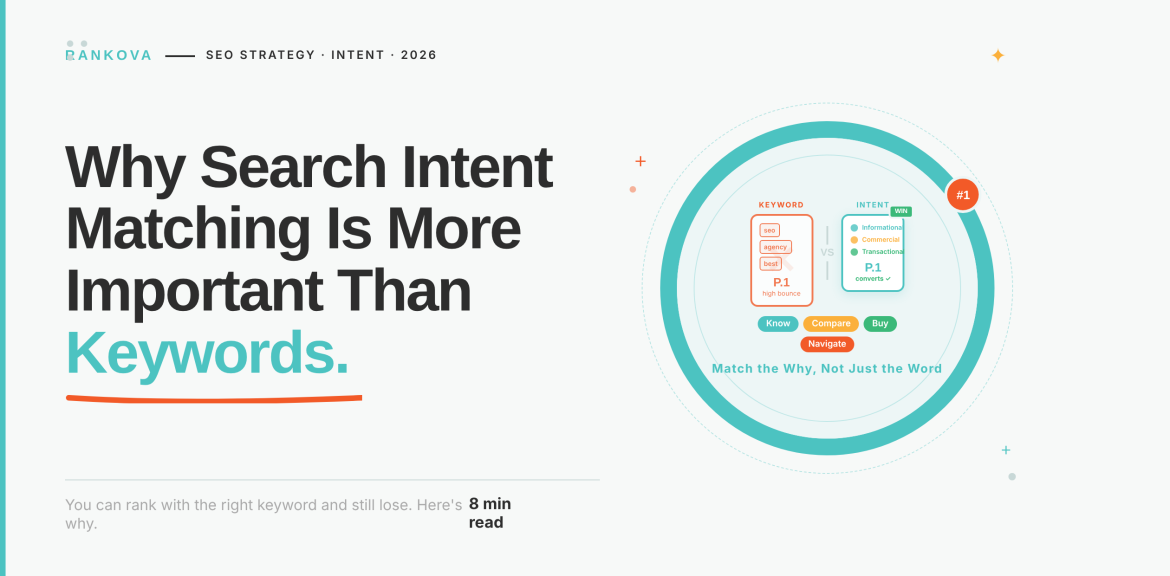
A page can contain the exact keyword someone searched for in the title, the headings, and the first paragraph, and still fail. During our content audit at Rankova, we observed that a page could have the right keyword, but answer the wrong question. Hence, it proves that search intent matching is more important than keywords.
That gap between matching someone’s words and matching what they came to do is what search intent means. It’s a bigger factor in whether content ranks, converts, or gets cited by AI tools than the keyword itself ever was.
Hence, this guide explains what search intent is, why thinking first about keywords keeps failing, a practical process for identifying intent before you write a word, and why this matters even more now that AI tools are answering questions directly. Let’s get into it.
Quick Answer: Why Does Search Intent Matter More Than Keywords?
Search intent matters more than keywords because Google and AI search tools rank content based on whether it satisfies the search intent. Two searches can share almost identical keywords and need completely different pages. If you build your page around the right keyword but the wrong intent, your visitors will leave quickly. This signals to Google that the page isn’t a good match, regardless of how well-optimized the keyword usage is. So, match intent first, then optimize keywords within that framework, to earn rankings, conversions, and AI citations.
What Search Intent Means
Search intent is the reason behind a search and not just the words used to search it. It answers the question keywords alone cannot: what job does this searcher need the page to do?
Search intent isn’t only about labeling a keyword as “informational” or “transactional” and moving on. Rather, it is about recognizing that the same keyword can carry different intent depending on the words around it, the searcher’s likely stage in their decision, and what Google already knows searchers expect to find.
For example, let’s examine “project management software.” On its own, that is a broad and exploratory search. However, the moment you add “for small teams,” it narrows the search toward comparison. If you add “pricing” to the same search, it shifts toward someone close to a buying decision but trying to check whether they can afford it. Finally, if we add “vs Asana,” it becomes a direct comparison between two specific options.
Now, we only add a core phrase at the start. However, four different additions change the narrative for us. This is why keyword-first content so often underperforms even when it’s well-written. It optimizes for the words without asking what those words were for.
Why Keywords Alone Keep Failing
Google explained why this shift happened, and it’s been underway for over a decade.
Before 2013, ranking leaned heavily on matching phrases and backlink volume. Google’s Hummingbird update changed that by introducing semantic understanding, the ability to grasp the meaning behind a query rather than just words. Subsequent updates pushed further in the same direction. It evaluated whether a page satisfies what a searcher wanted, using behavioral signals like click-through rate, time on page, and whether people immediately bounce back to the results and try something else.
That last signal matters more than most businesses realize. When a visitor lands on a page that matches their keyword but doesn’t match their intent, they leave within seconds. Google reads that pattern as evidence the page doesn’t satisfy the query. As such, rankings for that page tend to struggle even with strong keyword optimization.
So, Google will not push a page with the right keyword but wrong intent because it is making someone leave unsatisfied.
The Four Core Search Intent Types
Here are the four types of search intent;
- Informational: The searcher wants to learn something. Examples are “how does SEO pricing work” or “what is a content brief.”
- Navigational: The searcher is looking for a specific site or brand. Examples are “Rankova blog” or “Mailchimp login.”
- Commercial: The searcher is comparing options before deciding. The examples are “Best invoicing software for freelancers” or “Shopify vs WooCommerce.”
- Transactional: The searcher is ready to act. Examples are “Hire SEO agency Lagos” or “buy running shoes size 10.”
Which of the following is most ideal?
Real searches often blend all of these four types of search in their content. For example, “Best running shoes for beginners” looks purely commercial, but a thoughtful page for it should acknowledge that a true beginner might also have informational questions. So, you can explain ”how to tell if a shoe fits correctly” to match their intent. That way, you have satisfied the dominant intent while addressing the secondary one. This is what separates content that merely ranks from content that converts.
A Practical Process for Identifying Real Intent
According to Google, here’s a repeatable way to find out what a search wants.
Step 1: Search the term yourself, and read the page types
Open an incognito tab and search your target keyword. Look at what kind of pages occupy the top results. Are they mostly blog posts and guides? That signals informational intent. If they are product or service pages, that’s transactional. Commercial target comparison and “best of” roundups.
Google has done the hard work of figuring out what searchers want for this phrase across millions of searches. The results are the clearest intent signal available that you can use.
Step 2: Check the SERP features
Featured snippets, “People also ask” boxes, image packs, shopping results, and local packs are markers that tell you something about intent that the organic listings alone don’t. A shopping carousel above the results means Google has decided a meaningful share of searchers want to buy right now. A “People also ask” box full of basic definitional questions means a lot of searchers are still early in learning about the topic, even if the main keyword sounds decision-stage.
Step 3: Read the actual top-ranking content
Click into two or three of the top results. What questions do they answer? What do they assume the reader already knows? What format do they use? Is it a step-by-step guide, a comparison table, or a pricing breakdown? All of these tell you the depth and format Google has already confirmed satisfies this specific search.
Step 4: Separate the primary intent from the secondary one
Ask direct questions like: What is the main job this page needs to do, and is there a secondary question this same searcher is likely carrying that the dominant format doesn’t fully address? So, you can build the page around the primary intent. Then make sure the secondary question gets a real answer somewhere on the page.
Step 5: Match your content format to what you found
This is where thinking first about the keyword causes the most damage. A business that wants to publish a thought-leadership article will sometimes force that format onto a keyword that Google has clearly decided deserves a direct comparison table or a pricing page instead. The keyword might be right. The format is wrong, and the format is what intent should govern.
How Search Intent Matters in Nigerian Searches
The principles are the same everywhere, but a few patterns come up constantly in the Nigerian market. Here is an example using different pages on the Rankova blog;
- Price searches: A search like “how much does SEO cost in Nigeria” is a price-intent search. The visitor wants real numbers and what each tier includes, not a general essay on why SEO matters. An example is Rankova’s guide to what SEO costs in Nigeria in 2026.
- Local searches: Searches such as “restaurant in Lekki” or “dentist near me” usually expect map results and nearby businesses. If your customers search this way, start with Rankova’s guide on how to rank your business on Google Maps in Lagos.
- Searches shaped by the market itself: Phones, data costs, WhatsApp, and landmark-based addresses all change what Nigerian searchers expect to see. For the full picture, read how to rank on Google in Nigeria and what’s different about the Nigerian market.
What Happens When Your Search Intent Does Not Match Your Keyword
Picture a company that ranks on page one for “CRM pricing” with a narrative blog post about why CRM software matters for growing businesses. The keyword is right. But someone searching “CRM pricing” has already shown interest. They want numbers, tiers, and what’s included at each level. So, a persuasive essay about why CRMs are useful is not relevant to their search.
The visible damage shows up in three places:
- A high bounce rate, because visitors leave within seconds of realizing the page doesn’t have what they came for;
- A low time-on-page, because there’s nothing to engage with for their purpose; and
- The ranking itself sliding, because Google’s behavioral signals confirm the page isn’t satisfying this specific search, even though the topic and keyword are correct.
If you already have existing pages, you rarely need to start from scratch. Rankova’s step-by-step framework on how to repurpose old content to recover lost rankings shows how to rebuild an existing page around the right intent. And if your site gets visits but not enquiries, intent mismatch is one of the first places to look. Rankova covers the wider picture of why your website isn’t getting sales and how SEO fixes it.
A Real Example: Ridima, From Page Four to Page One
Here is how Rankova improved Ridima and helped it move from page four to page one.
Ridima is a fintech platform where users buy and sell gift cards, pay bills, buy airtime and data, and convert crypto to naira. It had a strong product, but it ranked on page four of Google. In practice, you will agree that that means being invisible. Rankova’s audit checked their technical health and competitors, and it also asked whether Ridima’s content matched its users’ search intent.
According to the audit, Ridima’s customers were not searching the industry label “FinTech platform Nigeria.” Rather, they were searching for a place to handle their digital financial needs. Rankova built the keyword strategy around that customer language, then aligned the content on each page with the intent behind its target keyword. We also carried out technical fixes, rewrote title tags and meta descriptions, restructured headings, and improved internal linking.
Ridima reached page one for its primary target keyword in 60 days, and shortly afterward appeared as a cited source in a Google AI Overview. Intent alignment was one part of a wider program. However, it is a clear picture of the gap between describing your business in your own words and matching the words and purpose your customers bring to Google. Read the full Ridima case study: how Rankova ranked a business on page one in 60 days.
Why This Matters Even More for AI Search
If anything, the AI search era has raised the cost of getting intent wrong.
Google’s AI-powered features and tools like ChatGPT often perform what’s known as query fan-out. That means, behind a single question, the system runs several related searches across different angles before assembling one answer. A page that only satisfies the keyword, without addressing the underlying question and its natural follow-ups, has a narrow chance of being pulled into that answer. Instead, you should ensure your page clearly demonstrates an understanding of the full shape of what the searcher wants.
This is also why keyword-stuffed content has become actively counterproductive in AI search. AI systems can detect and reward content that reads like it understands the question, in natural language, over content that reads like it’s targeting a phrase. The businesses showing up most often in AI-generated answers right now are the ones whose content genuinely satisfies a question rather than repeating a target phrase.
To put this into practice, read Rankova’s guides on how to get cited by Google AI Overviews and how to make your business show up in ChatGPT answers.
Common Mistakes Businesses Make
Here are the common mistakes businesses make;
- Picking the keyword, then forcing a format onto it.
- Treating the four intent categories as fixed labels
- Writing the page the business wants to publish.
- Ignoring behavioral signals after publishing.
- Assuming intent is permanent.
Intent mismatch is only one avoidable error. For a wider checklist, see 7 SEO mistakes that are killing your website traffic in 2026.
Frequently Asked Questions About Search Intent Matching
Here are frequently asked questions about search intent matching;
Question 1: What is search intent in SEO?
Search intent is the reason behind a search. It is the job a searcher needs a page to do, not the literal words in the search box. Google ranks content based on how well it satisfies that underlying intent.
Question 2: What are the main types of search intent?
The four commonly recognized types are informational (learning something), navigational (finding a specific site or brand), commercial (comparing options), and transactional (ready to act).
Question 3: How do I find the search intent behind a keyword?
Search the keyword yourself and study what already ranks. You can use the page types, the SERP features like featured snippets or shopping results, and the format and depth of the top-ranking content.
Question 4: Can a page rank for a keyword but still fail at search intent?
Yes, and it’s one of the most common ways SEO effort gets wasted. A page can contain the right keyword and still see high bounce rates, low time-on-page, and declining rankings if it doesn’t satisfy what the searcher came to find.
Question 5: Does search intent matter for AI search and AI Overviews too?
Yes, arguably more than for traditional search. AI tools often break a single question into several related sub-questions before assembling an answer. They favor content that reads like a natural-language answer to the real question over content that reads like it’s targeting a keyword phrase.
Question 6: Should I stop doing keyword research altogether?
No. Keyword research still matters for finding what people are actually searching and estimating demand. Identify the intent behind a keyword first, build the right format and depth for that intent, then optimize the keyword usage within that structure.
How Rankova Builds Content Around Intent
Matching search intent isn’t a separate skill from SEO. It’s the difference between SEO that produces traffic and SEO that produces customers. At Rankova, every piece of content starts with the same question this guide walks through.
That’s also exactly the kind of judgment a generic keyword list can’t make for you. It’s why Rankova’s audit includes a content check on whether your pages match the intent behind the keywords they target. This same check shaped the Ridima engagement above. If you want to see what that work looks like week to week, read what an SEO agency actually does day-to-day. To judge whether your current agency is checking this at all, see how to tell if your SEO agency is actually working.
Want a second opinion on whether your top pages actually match what searchers came to do? Talk to Rankova, and we’ll show you where the mismatches are costing you.
Conclusion
A keyword tells you what someone typed. Search intent tells you why they typed it. A good workflow will combine both to rank a page, keep visitors, convert them, and feature in an AI-generated answer. The fix doesn’t require abandoning keyword research. Rather, it understands the job behind a search first, and builds the format and depth that job calls for. If you do them consistently, your page will perform better. For more help, consult Rankova today.
If you enjoyed this, read more here;
Case Study: How We Ranked a Business on Page 1 in 60 Days
How to Get Cited by Google AI Overviews
How to Make Your Business Show Up in ChatGPT Answers
Internal Linking Strategy: The Most Overlooked SEO Tactic. – SEO & AI Search Optimization Agency
How to Rank on Google in Nigeria: What’s Different About the Nigerian Market?
Pingback:Best SEO Agency for Schools and Educational Institutions in Nigeria - SEO & AI Search Optimization Agency