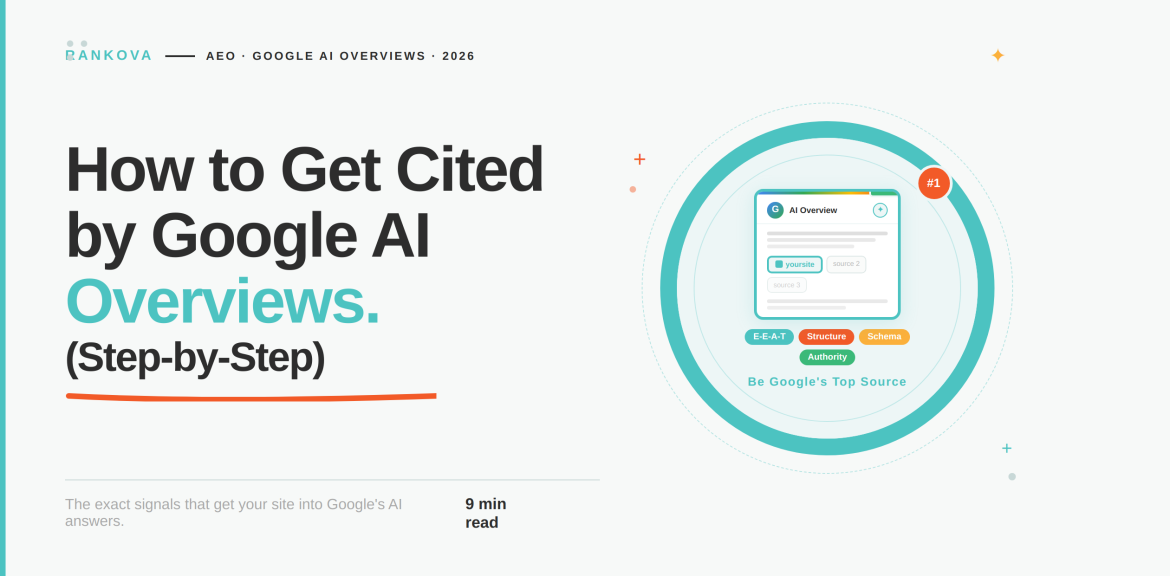
Type a product or service into Google right now. Yes, there is always an answer that appears above other results. That box is an AI Overview. The truth about this is that most customers are satisfied with these answers. Hence, any serious business today should know how to get cited by Google AI overviews.
This is for a business owner or marketer who wants a straight answer. First, you will learn how Google chooses what to cite. Also, you will see the page structure that earns citations, how to check your business citation (for free), and the mistakes that can rule your page out. Let’s get into the article.
Quick Answer: How Do You Get Cited by Google AI Overviews?
To get cited by Google AI Overviews, you need to rank on page one, as most citations come from pages Google already considers strong results. Then answer the question in the first sentence of the relevant section. Use clear question-style headings, short paragraphs, and structured lists. Back claims with experience, data, or examples. Keep the page fresh, fast, and readable without JavaScript. Finally, build genuine off-site mentions for Google to weigh whether other sources agree with what your page says.
What an AI Overview Citation Looks Like
An AI Overview is the AI-generated summary Google shows above traditional results for many searches. Beneath or beside that summary are small source links. They usually come as a row of website icons or a “sources” list you can expand. If your page is one of those links, your citation is good. If the AI Overview describes your brand or product without a link back to you, that is a mention and not a citation. While both are worth tracking, only a citation sends you a visitor.
Google has said that there are no special technical requirements or necessary schema to appear in AI Overviews. If your SEO is standard, you have a higher chance of showing up in AI citations.
How Google Selects What to Cite
Here are the ways Google selects what to cite;
- It starts with your organic ranking
Independent analyses of large citation samples consistently find that most AI Overview citations come from pages that already rank on page one organically. If your page is nowhere near page one for a query, structural fixes to that page will not fix the deeper problem.
That said, ranking alone is not enough either. A separate large-scale analysis found that well under half of cited URLs held a top-10 spot for the exact query the AI Overview was answering. Google is not simply promoting its number-one result into the summary. Rather, it is assembling an answer from several sources, some of which rank well for the main query and some of which rank well for a related sub-question you may not have thought to target directly.
- Google asks more questions than you typed
This is the part most business owners miss. Google’s AI features can run a query behind a single search. Google issues several related searches across subtopics before assembling one answer. A search for “best invoicing software for small businesses in Nigeria” might trigger separate lookups for pricing, for specific features, and for comparisons with named competitors.
Practically, this means a page that answers only the headline question has one shot at citation. A page that also answers the two or three sub-questions a reader would naturally ask next has several shots, because each sub-answer can be pulled into a different part of the summary.
- It rewards a direct answer over broad coverage
Analyses of citation patterns show a consistent preference. Pages that answer one specific question with depth get cited over pages that mention many things loosely. A page trying to be the definitive resource on an entire topic often loses out to a narrower page that nails one precise question the searcher actually asked.
A practical formatting checklist
Here is a practical formatting checklist if you want Google AI overviews to cite your business;
- Write headings as the question a reader would type or ask. E.g., “How much does invoicing software cost?”
- Answer in the first sentence under each heading.
- Keep paragraphs to two or three sentences. AI systems extract discrete chunks of text.
- Use bullet lists and tables for anything comparable or sequential. Structured formats are easier to parse than the same information in prose.
- Build a genuine FAQ section at the end, with each question answered fully in its first sentence.
- Avoid JavaScript-dependent rendering for your core content. If the answer only appears after a script runs, some crawling and extraction paths may not reliably see it.
Build the Trust Signals Google Is Checking For
Here is how to build the trust signals Google is checking for;
- Show first-hand experience.
A page that is from direct experience, real pricing, a real process, a real example, will read differently from generic advice. Google’s own guidance on helpful content treats this as a foundational quality signal for both traditional and AI-powered search.
- Attribute claims and name real people.
An article with a visible author, a clear basis for their expertise, and sources cited for anything factual is a stronger citation candidate than uncredited content.
- Keep the page current.
You need to frequently review or update your content to improve its potential for citation
- Build a genuine off-site footprint.
Google is not only reading your page in isolation. Rather, it is weighing whether other sources, industry publications, forums, review sites, and mentions elsewhere generally agree with what your page claims. A page making an unusual claim with zero outside corroboration is a harder sell than one with other attesting claims. You do not need a PR department for this. A few genuine mentions in relevant industry publications, real customer reviews, and authentic discussion of your brand in the right forums all contribute.
How to Check Whether You’re Already Being Cited (for Free)
You do not need a paid citation-tracking tool to get started. Here are two free methods that work well.
- Google Search Console’s AI features report.
Google rolled out dedicated Search Generative AI performance reporting through 2026. In it, they separated impressions and clicks that came from AI Overviews and AI Mode from standard organic results. If your site is verified in Search Console, check the Search Results report and filter or review the search appearance breakdown for AI features. With real data, you can tell whether your pages are showing up in AI-powered results before you optimize anything.
- Manual spot-checks.
Search your five to ten most important queries yourself on desktop and mobile. Then, note whether an AI Overview appears, and you feature in citations. Do this over a few weeks. Once you know your baseline, you can track it the same simple way monthly. That is a perfectly functional tracking system for a business that is not running dozens of content properties.
Common Mistakes That Rule Pages Out
Here are common mistakes that kill the potential for Google AI overview citation;
- Chasing AI Overviews before you rank at all.
If your page is not on page one organically, structural polish will not compensate for the fact that Google does not yet consider it a strong result for the query.
- Burying the answer under a long introduction.
Be straight to the answer within the first sentence.
- Writing shallow coverage instead of a specific answer.
A page trying to say something about everything usually says nothing precise enough to serve as a clean citation.
- Treating FAQ sections as an SEO afterthought.
A vague FAQ wastes one of the strongest citation opportunities on the page.
- Letting pages go stale.
An unreviewed page in over a year, especially one with prices, availability, or facts that change, is a weaker citation candidate.
- Relying only on your own site for proof.
Zero off-site mentions or discussion means Google has nothing external to check your claims against.
- Gating the real content behind heavy JavaScript.
If the answer isn’t reliably present in the page’s underlying content, don’t assume it will still be extracted correctly.
Does Schema Markup Help?
It helps indirectly. Structured data such as FAQ or HowTo schema does not force a citation. However, it gives Google a cleaner signal about what your content is and how it’s organized. If you don’t understand basic schema yet, Rankova’s plain-English guide to schema markup is a reasonable next step after you’ve fixed page structure and answer placement.
You may also see claims online about special files or shortcuts that supposedly unlock AI citations on their own. Be skeptical of anything promising a shortcut around the fundamentals above. Rankova has written honestly about one popular example in what an llms.txt file actually does and whether your site needs one.
Frequently Asked Questions About Google AI Overview Citations
Here are frequently asked questions about Google AI Overview citations;
Question 1: What’s the difference between a citation and a mention in AI Overviews?
A citation is a link. The AI Overview links directly to your page as a source. A mention is when your brand or product is named in the summary without a link back to you. Note that citations drive traffic while mentions build awareness.
Question 2: Do I need to rank number one to get cited?
No, you generally need to rank on page one. Google pulls citations from a mix of sources across the top results and not exclusively position one. So, a page ranking sixth with a sharper and better-structured answer can outperform a page ranking first with a buried one.
Question 3: Does adding FAQ schema guarantee more citations?
No. Schema is a supporting signal and not a guarantee. What matters more is whether each FAQ answer is genuinely direct in its first sentence and answers a real question your audience asks.
Question 4: How long does it take to start earning AI Overview citations?
If a page is already ranking on page one, structural improvements can show results within weeks. If the page isn’t ranking yet, you need to build the organic SEO foundation. This can take longer, as it depends on competition in your space.
Question 5: Can a small business compete for AI Overview citations against bigger brands?
Yes. AI Overviews cite the best specific answer to a question. A small business with genuine, detailed, and first-hand expertise on a narrow question can out-cite a much larger competitor whose content on that specific question is generic.
How Rankova Helps Businesses Get Cited
Getting cited by Google AI Overviews is not a trick you bolt onto a website. It’s the outcome of a page that ranks well, answers precisely, and Google trusts well. That is the same work Rankova does for businesses every day.
Rankova is an SEO and AI search optimization agency. We help businesses build the foundation covered in this guide. If you want a clearer picture of what that work looks like week to week, read what an SEO agency actually does day-to-day.
Want to know whether your site is already showing up in AI Overviews, and what’s holding it back if it isn’t? Talk to Rankova, and we will show you exactly where you stand.
Conclusion
Getting cited by Google AI Overviews rewards the same discipline good SEO always has. These include being able to rank well, answer precisely, and earn real trust. The pages winning citations right now are ranking on page one, answering the actual question in the first sentence, and backing that answer with real experience and outside corroboration.
Start with your own top pages. Find where the real answer sits on each one. If it’s buried past the first third of the page, that is the fastest fix available to you today. Contact Rankova today to get the perfect assistance for your business.
If you enjoyed this, read more here;
- What Is Schema Markup? A Plain-English Guide for Business Owners
- How to Fix a Website That Google Won’t Index
- How to Make AI Systems Recognize and Trust Your Brand
- What Is an llms.txt File and Does Your Website Need One?
- How to Repurpose Old Content to Recover Lost Rankings
- What Does an SEO Agency Actually Do Day-to-Day?
Pingback:Topical Authority Explained: How to Build It and Why It Determines Your AI Visibility - SEO & AI Search Optimization Agency