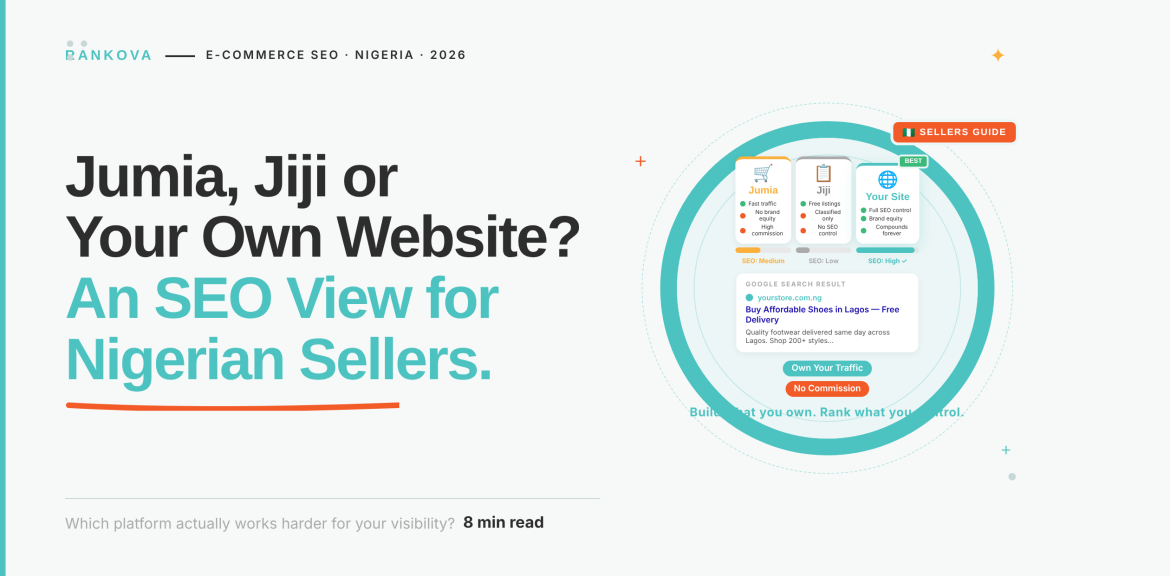
Jumia and Jiji give Nigerian sellers fast access to buyers. Your own website gives you traffic, customers, and search rankings you own. For most growing sellers, the best answer is not choosing between Jumia, Jiji, or your own website. Rather, use Jumia and Jiji for reach, and build your website as the home of your brand. However, the question every Nigerian seller faces is: which should take more attention?
Most guides answer with a list of pros and cons. This guide looks at it differently. It asks one question: when a customer searches on Google or asks ChatGPT for what you sell, who gets found, and who keeps the customer?
That question decides whether you are building a business or renting a stall.
Key takeaways
- Jumia brings ready buyers and delivery support, but takes a commission on every sale and controls the customer.
- Jiji is free to start and strong for local, negotiable sales, but you compete on price in a crowded feed.
- Your own website costs time and money to grow, but every visitor, review, and ranking builds value for you.
- Marketplace listings help the marketplace rank, not you. The Google rankings belong to jumia.com.ng and jiji.ng.
- The smart path for most sellers: use marketplaces for sales today, and grow your own website for the business you want in three years.
Which is better for Nigerian sellers: Jumia, Jiji, or your own website?
There is no single winner. The right choice depends on what you sell, how much you can spend, and how big you want to grow. Use this quick guide:
- Jumia is the go-to if you sell new, branded products, want delivery handled for you, and can price in a commission.
- Choose Jiji if you sell used items, cars, property, phones, or local services, and you like closing deals by phone or chat.
- Choose your own website if you want to build a brand, keep your customers, and stop paying commission on every sale.
- Combine all if you want sales now and a stronger business later. This suits most growing sellers.
The rest of this guide explains why, through the lens most sellers ignore.
The SEO question most sellers miss: who owns the traffic?
When you sell on a marketplace, Google ranks the marketplace’s page, not your business. The traffic, the rankings, and the customer data belong to Jumia or Jiji.
Search “buy non-stick pot set Lagos” on Google. You will likely see marketplace pages, such as Jumia’s or Jiji’s, among the results. Those pages may show your product. But the web address is jumia.com.ng or jiji.ng. Every click, every review, and every backlink makes their website stronger.
You can think of it like renting a stall in a big market. The market brings the crowd. But if you move, the crowd does not follow you. They respond to the market.
However, your own website works like owning your shop. It starts quiet. But every customer who visits, every review you earn, and every page Google ranks adds to an asset you keep. Over time, people search for your brand name directly.
In this era of AI search, a shopper asks ChatGPT, “Where can I buy quality Ankara bags in Lagos?” ChatGPT reads websites, reviews, and articles to decide whom to name. A seller with only marketplace listings is easy to overlook. A seller with a clear website, reviews, and mentions gives AI something to cite. Our guide to ChatGPT shopping for online stores explains how this works.
Selling on Jumia: pros, cons and the SEO view
Jumia is Nigeria’s best-known online mall. It brings buyers, payment and delivery support, and charges a commission on each sale.
What works well:
- Ready buyers. Many Nigerians already trust Jumia and search there first.
- Delivery and payment support. Jumia handles much of the logistics and payment for you.
- There is no upfront listing fee. You only pay when you sell.
What to watch:
- Commission on every sale. Rates depend on the product category. Seller guides put them roughly between 5% and 20%. Check your rate in Jumia’s Seller Center before you set prices.
- Strict rules. Jumia sets the policies, fees, and penalties, including tough fines for counterfeit goods. It can change them at any time.
- Price competition. Other sellers may list the same product on the same page. Shoppers often pick the cheapest.
- Weak brand memory. Buyers tend to remember “I bought it on Jumia” and not your store name.
The SEO view
Jumia’s strong website helps your listing appear on Google quickly. That is a real benefit. But you build Jumia’s rankings, not yours. If you leave, your reviews and visibility stay behind.
Selling on Jiji: pros, cons and the SEO view
Jiji is a classifieds site. You post ads for free, and buyers contact you directly to talk and agree on a price.
What works well:
- Free to start. You can post ads without paying. Jiji earns from optional paid boosts and top-ad packages, according to its billing policy.
- Huge reach. Jiji reports more than 90 million annual users across its platforms, according to Wikipedia’s profile of Jiji Africa.
- Direct contact. Buyers call or chat with you. You get their number, which Jumia rarely gives you.
- Strong for certain categories. Cars, phones, property, used items, and local services do well.
What to watch:
- Pay to stand out. Free ads can sink fast in a busy feed. Many sellers end up paying for boosts again and again.
- Price haggling. Buyers often come to bargain hard.
- Trust concerns. Scams on classifieds sites make some buyers cautious.
- Short life. Ads expire or drop down. Nothing builds up over time.
The SEO view
Jiji’s category pages rank well on Google, so your ad can get seen. But each ad is temporary. When it expires, its visibility goes with it. You start again next week.
Selling on your own website: pros, cons, and the SEO view
Your website is a store you control. You set the prices, keep the customer details, and pay no commission. However, you must bring the traffic.
What works well:
- No commission. You keep the full sale, minus payment and delivery costs.
- Your customers, your data. You collect emails and phone numbers, and sell to people again.
- Your brand. Your design, your story, your reviews. Buyers remember your name.
- Long-term search value. Every page Google ranks keeps working for you.
- AI visibility. Tools like ChatGPT and Google’s AI answers can cite your pages and recommend your store.
What to watch:
- Upfront cost. You pay for a domain, a store platform or hosting, and setup.
- Slow start. SEO usually takes months to build traffic. You need patience or another traffic source in the meantime.
- Trust must be earned. New buyers need proof that you are real: reviews, clear policies, and contact details.
- You do the work. Delivery, payments, and customer service sit with you or the partners you choose.
The SEO view
This is the only option where your search rankings belong to you. Each product page, blog post, and review strengthens your own website. In three years, that asset can bring sales every day without boosts or commissions.
The smart path: use marketplaces and your website together
You don’t have to choose only one. The strongest Nigerian sellers use marketplaces for reach and their own website as home base.
Think of it in three stages:
- Start where the buyers are. List on Jumia or Jiji to test products and make your first sales. Learn which products move and at what price.
- Build your home base. Launch a simple website with your best products, clear prices, delivery details, and a WhatsApp button. Set up your Google Business Profile and link it to your website.
- Shift the balance over time. Use the same brand name everywhere. Ask happy customers to review you on Google and your website. Share your website link on Instagram, TikTok, and WhatsApp. As your website grows, depend less on commissions and paid boosts.
Marketplaces have rules about sending buyers elsewhere. Read Jumia’s and Jiji’s seller policies before you add your website or phone number to listings or packages. Breaking those rules can get your account suspended.
The goal is simple. Marketplaces pay your bills today. Your website builds the business you will own tomorrow.
How to get your own store found on Google and AI search
A website only helps if people can find it. These steps give a Nigerian online store its best chance on Google and in AI answers.
- Search the way your buyers search. Nigerians often type “price of laptop in Nigeria”, “laptop in Lagos” or “original brand near me”. Use those exact phrases in your titles, headings, and product descriptions.
- Write your own product descriptions. Don’t copy supplier text that fifty other stores use. Explain what the product is, who it suits, and what makes it worth buying.
- Include naira prices. “DM for price” stops Google, ChatGPT, and shoppers from comparing you. Clear prices win clicks.
- Make every page fast on phones. Most Nigerian shoppers browse on mobile data. Compress images and keep pages light. See Core Web Vitals explained.
- Show trust signals. Display your address, phone number, WhatsApp, delivery areas, return policy, and real reviews.
- Answer buyer questions in articles. Write helpful guides such as “how to spot original perfume in Nigeria”. These pages attract searchers and lead them to your products. Our guide on writing a blog post that ranks shows how.
- Get mentioned elsewhere. Reviews, local blogs, news features, and “best of” lists help Google and ChatGPT trust your brand.
- Claim your local listings. A complete Google Business Profile helps you appear on Google Maps and local searches. Our no-budget local SEO guide walks you through it.
For more Nigeria-specific tactics, read how to rank on Google in Nigeria.
Mistakes Nigerian sellers make with marketplaces and websites
Here are the mistakes Nigerian sellers make with marketplaces and websites;
- Putting everything on one marketplace. One policy change, fee rise, or account suspension can stop your sales overnight.
- Building a website and waiting. A website without SEO, social sharing, or WhatsApp promotion stays empty. Plan how people will find it.
- Using different names everywhere. If your Jumia store, Instagram, and website use different names, buyers and Google can’t connect them.
- Hiding prices. “DM for price” loses shoppers who compare options quickly.
- Ignoring reviews. Reviews build trust on every platform. Ask for them after every delivery.
- Breaking marketplace rules. Pushing buyers off-platform against the rules can cost you your account.
- Expecting overnight results. Marketplace sales can start fast. Website traffic from SEO builds over months. Plan for both.
How Rankova helps Nigerian sellers build traffic they own
Marketplaces can bring your first sales. Rankova helps you build the website traffic that keeps your business growing without commissions or endless boosts.
Here is how we help:
- We map your path. We look at what you sell and where you sell it today. Then we plan how to grow your own website alongside your marketplace sales.
- We find the searches that matter. We research how Nigerian buyers search for your products on Google and in AI tools.
- We fix your website foundations. We check speed on phones, indexing, and technical issues that hold your store back.
- We improve your product and category pages. We make them clear, complete, and ready to rank and convert.
- We build your reputation. We help you earn genuine reviews and mentions on the websites Google and ChatGPT trust.
- We report in plain English. Every month, you see your rankings, traffic, and sales from search, and what we will do next.
We work with Nigerian businesses every day. We understand mobile-first shoppers, WhatsApp orders, and the trust gap many online buyers feel. So, we promise steady work that builds an asset you own, and clear reporting on the results.
Frequently Asked Questions About Jumia, Jiji, or Your Website
Here are frequently asked questions about Jumia, Jiji, or your website;
Question 1: Is it better to sell on Jumia or Jiji?
It depends on what you sell. Jumia suits new, branded products and sellers who want delivery support. Jiji suits used items, cars, phones, property, and local deals where buyers like to call and negotiate.
Question 2: Do I need a website if I already sell on Jumia or Jiji?
You can sell without one. But a website gives you a store you control, customers you keep, and search rankings in your own name. It also protects you if a marketplace changes its fees or rules.
Question 3: How much does Jumia charge sellers?
Jumia charges a commission on each sale, based on the product category. Seller guides put rates roughly between 5% and 20%. Check your rate in Jumia’s Seller Center before you price your products.
Question 4: Is Jiji free for sellers?
Yes, posting a basic ad is free. Jiji also sells optional paid boosts and top-ad packages that make your ads more visible.
Question 5: How long does it take for my own website to rank on Google?
Most new websites take several months to build steady traffic from Google. Progress depends on your competition, content, and website quality. Use marketplaces and social media to make sales while your website grows.
Conclusion
Jumia and Jiji are useful places to sell, but you rent their crowd. Your own website is where you own the traffic, customers, and rankings. Use marketplaces for today’s sales. Build your website for tomorrow’s business.
Are you ready to build traffic for your website? Talk to Rankova. We will review your current sales channels, check your website, and show you the fastest path to customers who find you directly.
Read more
How to rank on Google in Nigeria
Best AEO agency for e-commerce in Nigeria
Local SEO for small businesses in Nigeria
Internal Linking Strategy: The Most Overlooked Seo Tactics
How to get more Google reviews in Nigeria
What is schema markup? A plain-English guide
Sources
Jumia VendorHub Nigeria: commissions
How to sell on Jumia as a Nigerian vendor