An important rule in marketing is to go where the people are. Since people are now more on their phones, many businesses have relied on search engine optimization (SEO), digital marketing, and social media advertising to reach a larger audience. However, this is 2026, and people are not relying on these platforms alone anymore to make searches.
Here is a quick story. A founder once spent twelve months building what she thought was a strong SEO presence. As a matter of fact, her company ranked on page one for three competitive keywords, and traffic was growing. Similarly, everything looked good in the reports.
One day, a potential client mentioned, almost in passing, how they found the company they decided to hire. Her response was, “I just asked ChatGPT which agencies were best for our type of business, and your name didn’t come up.”
The founder went home and typed the same question. Five competitors appeared by name, but her company was completely invisible. Well, what is missing is called Answer Engine Optimization (AEO).
In this article, you will learn about AEO, why it matters for your business, how it compares to SEO, and how to build your AEO visibility. Welcome to the perfect guide your business needs for all-round visibility.
What Is Answer Engine Optimization (AEO)?
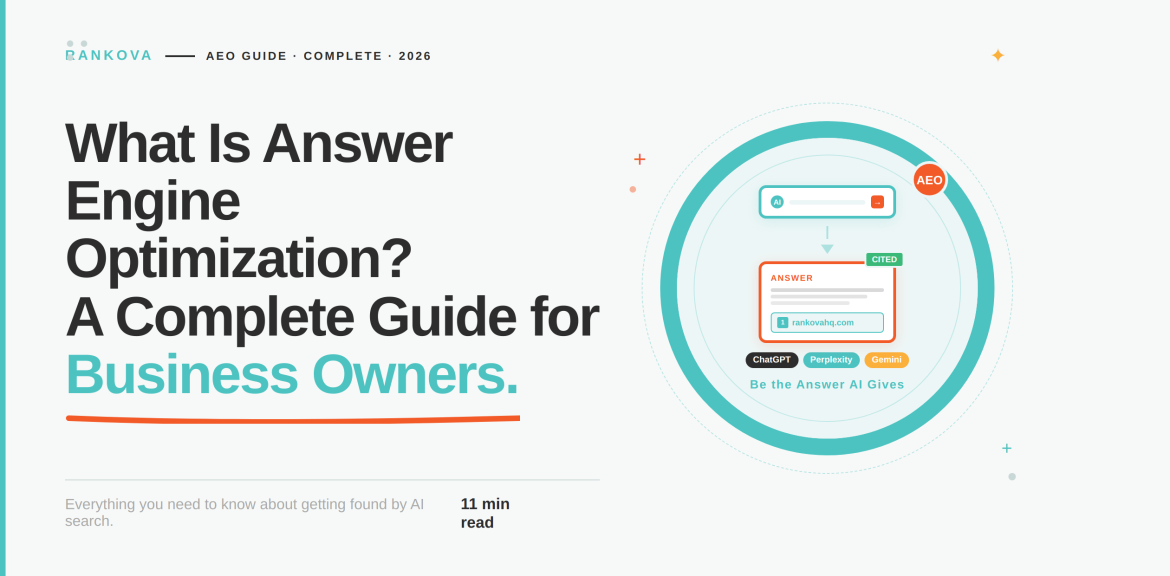
Answer Engine Optimization (AEO) is the process of optimizing your content, brand signals, and digital presence so that AI-powered platforms can understand, trust, and recommend your brand when buyers ask relevant questions.
Where traditional SEO focuses on ranking pages in a list of search results, AEO focuses on becoming the answer itself. That means the brand AI systems will directly cite your business when someone asks for a recommendation, a comparison, or expert guidance in your category.
Why Does AEO Matter for Your Business?
You would agree that search behavior has shifted dramatically. More than half of all Google searches now end without a single click because AI systems deliver the answer directly inside the search experience. With AEO, the user does not have to visit a website or click on a page. With the recommendation, they are good to go.
Here is a statistic that shows why AEO matters for your business;
Research tracking 312 B2B companies found that visitors arriving from AI platforms converted at an average rate of 14.2%, compared to 2.8% for visitors from traditional Google search. This means AEO has roughly five times the conversion rate as traditional SEO.
Well, the reason is straightforward. Buyers who arrive from an AI recommendation have already been pre-qualified. Let me explain.
These buyers are in their decision-making phase. They asked a question, received a recommendation that included your brand, and then sought you out specifically. At this point, they are not browsing but have already decided you are credible.
If your brand is not in the AI’s answer, you are not on the consideration shortlist then.
AEO vs. SEO: The Key Difference
What are the key differences between traditional search engine optimization and answer engine optimization? This table details all you need to know about AEO and SEO.
| Metrics | Traditional SEO | Answer Engine Optimization |
| Goal | Rank in a list of results. | Become the cited answer. |
| User experience | User chooses from multiple results. | User receives one synthesized answer. |
| Key signals | Keywords, backlinks, and page authority. | Extractability, topical authority, and brand trust. |
| Measurement | Rankings and organic traffic | Citation frequency and branded search volume. |
The most important distinction is that SEO makes you visible to people who are searching. AEO makes you the recommended answer when buyers are deciding.
Note that those are different positions in the buying journey, which show different levels of trust to start a conversation from.
How the Buyer Journey Has Changed
Five years ago, buyers searched on Google, clicked through several results, compared options, formed a shortlist, and then contacted companies.
Today, a growing proportion of buyers just ask ChatGPT or Perplexity a specific question, receive a synthesized answer with named recommendations, note those brands, and then do additional research on those specific companies.
The shortlist is now formed at the AI answer stage and not during website comparison.
This is why AI-referred visitors convert at five times the rate of traditional organic visitors. They arrive having already been recommended. If your brand is not in the AI answer, you never entered the consideration set.
Which Platforms Matter for AEO
Here are the platforms that matter for AEO;
- Google AI Overviews: this appears at the top of search results for a growing range of queries. It helps to reduce click-through rates on traditional results by over 50% for the queries they cover.
- ChatGPT: this is the most widely used conversational AI globally. Buyers use ChatGPT to ask for recommendations, compare options, and get guidance before they visit any website.
- Perplexity: this is purpose-built as an AI search engine and always cites three to four sources per response. It is arguably the most transparent source of referral traffic from AI platforms due to its multiple options.
- Voice assistants: These include Siri, Alexa, and Google Assistant. They are designed to respond with a single answer. As such, the recommended brand is the only brand the user hears.
How AI Platforms Decide What to Recommend
Here are four factors that consistently determine if your brand gets cited or not.
- Relevance to the specific question: Is your answer relevant to the specific question? The reason is that AI systems decompose queries into sub-questions. You should know that generic service pages rarely earn citations. Hence, you should provide specific yet detailed answers to the exact questions your buyers ask.
- Content extractability: AI systems scan for self-contained passages they can lift cleanly. They follow an answer-first structure, where the key insight comes in the first sentence of each section.
- Brand authority: A page from a brand with consistent presence across multiple platforms beats a technically perfect page from an unknown brand. AI systems learn which brands to trust through repeated and consistent exposure. So, strengthen your brand authority to increase the chance of being recommended by AI platforms.
- Content freshness: AI platforms prefer recent content over older content. Hence, it will most likely cite a well-structured page that has been recently published over an identical page that was published two years ago without updates.
How to Build AEO Visibility: Five Core Actions
Here are five core actions to build your AEO visibility;
- Write answer-first content.
Open every major section with a direct and complete answer. Follow with supporting detail. AI systems extract clean opening passages and not paragraphs buried three sentences into a section.
- Implement structured data.
FAQPage schema packages your question-and-answer content in a format AI systems. The reason is to extract it at significantly higher rates. So, you should add Article schema on blog content and Organization schema on your homepage at minimum.
- Create an llms.txt file.
This file tells AI crawlers what your website covers and which pages matter most. Most websites don’t have one yet. However, creating one immediately differentiates you from the majority of competitors.
- Build off-site brand presence.
AI systems cite brands they have encountered consistently across multiple independent sources. Brand mentions across credible platforms signal trustworthiness to AI systems in a way that a single well-optimized website cannot.
- Ensure AI crawlers can access your site.
Check your robots.txt file. If PerplexityBot, GPTBot, or ClaudeBot are blocked, your content will struggle to be crawled or cited by those platforms. This is one of the fastest and highest-impact fixes most businesses can make.
Important to Note: AEO Does Not Replace SEO
It is important to note that AEO does not work against SEO. Rather, it supports it to ensure maximum visibility. Traditional Google rankings still drive significant traffic. Strong organic rankings are also one of the signals AI platforms use when evaluating which content to cite. The businesses winning in search in 2026 are those optimizing to appear in traditional search results and in the AI-generated answers.
Another beautiful thing about AEO is that its authority compounds. The brands establishing themselves as AI recommendations now will be the default recommendations in subsequent years. As such, recent challengers who arrive later will have to displace an established position. Hence, you can always have a head start today before others come in.
The brands in your market who act now are building an advantage that grows every month. The ones waiting are watching competitors earn that position while they optimize for a version of search that no longer tells the full story.
Frequently Asked Questions About Answer Engine Optimization.
Here are some of the frequently asked questions about answer engine optimization;
Question 1: What is answer engine optimization?
Answer engine optimization (AEO) is the process of making your brand visible and citable in AI-generated answers on ChatGPT, Google AI Overviews, Perplexity, and voice assistants. Where SEO helps you rank in search results, AEO helps you become the answer those systems deliver.
Question 2: How is AEO different from SEO?
SEO optimizes pages to rank in a list of results. AEO optimizes your brand to be cited in a synthesized AI answer. SEO prioritizes keywords and backlinks while AEO prioritizes content extractability, topical authority, and brand trust. However, you need to pursue both together.
Question 3: How long does AEO take to show results?
Most businesses see initial AI citation improvements within two to four months. However, meaningful and consistent brand presence in AI recommendations follows at four to eight months. You should also note that AEO compounds over time.
Question 4: Does AEO work for small businesses?
Yes, AEO works for both small and large businesses. As a small business, all you need is well-structured, genuinely relevant, and recently updated content to appear in AI citations alongside much larger competitors. If you are niche-specific, you have an advantage over large businesses.
Question 5: How do I know if I have an AEO problem?
Open ChatGPT or Perplexity and ask the questions your ideal customers ask about your category. If competitors appear and you don’t, you have an AEO visibility gap. Flat branded search volume despite growing organic traffic is another signal.
How Rankova Approaches AEO
At Rankova, the goal is to maximize visibility for all customers. As such, we build SEO and AEO together because the buyer’s journey doesn’t separate them.
For our clients, that means auditing current AI visibility across platforms, restructuring key pages for answer-first extractability, implementing structured data, creating llms.txt files, building off-site brand presence, and tracking citation frequency and branded search volume over time.
We work with SaaS and B2B tech companies, real estate agencies, and e-commerce brands. If your buyers are asking AI platforms for recommendations in your category and your name is not appearing, the audit is where that changes.
Reach Rankova today and let’s get started with a free audit.
If you enjoyed this, read more here;
Technical SEO checklist: 20 Things to Audit Before Anything Else
How to Rank Your Business Higher Than Others (Step-by-Step)
Best AEO Agency for E-commerce and Shopify Stores.
How to Get Cited by Perplexity (Step-By-Step) – SEO & AI Search Optimization Agency
How to Measure ROI on SEO and AEO Services – SEO & AI Search Optimization Agency
The Best SEO Agency for E-commerce and Shopify Stores
How to Make Your Business Show Up in ChatGPT Answers
The Best AEO Agency for Dentists and Healthcare – SEO & AI Search Optimization Agency
Pingback:How to Write a Blog Post That Ranks on Google - SEO & AI Search Optimization Agency
Pingback:GEO vs SEO vs AEO: What's the Difference and Which One Does Your Business Need? - SEO & AI Search Optimization Agency
Pingback:How to Get More Google Reviews in Nigeria (Without Being Awkward About It) - SEO & AI Search Optimization Agency
Pingback:How to Make AI Systems Recognize and Trust Your Brand - SEO & AI Search Optimization Agency
Pingback:Best SEO Agency for Restaurants and Food Businesses in Nigeria - SEO & AI Search Optimization Agency