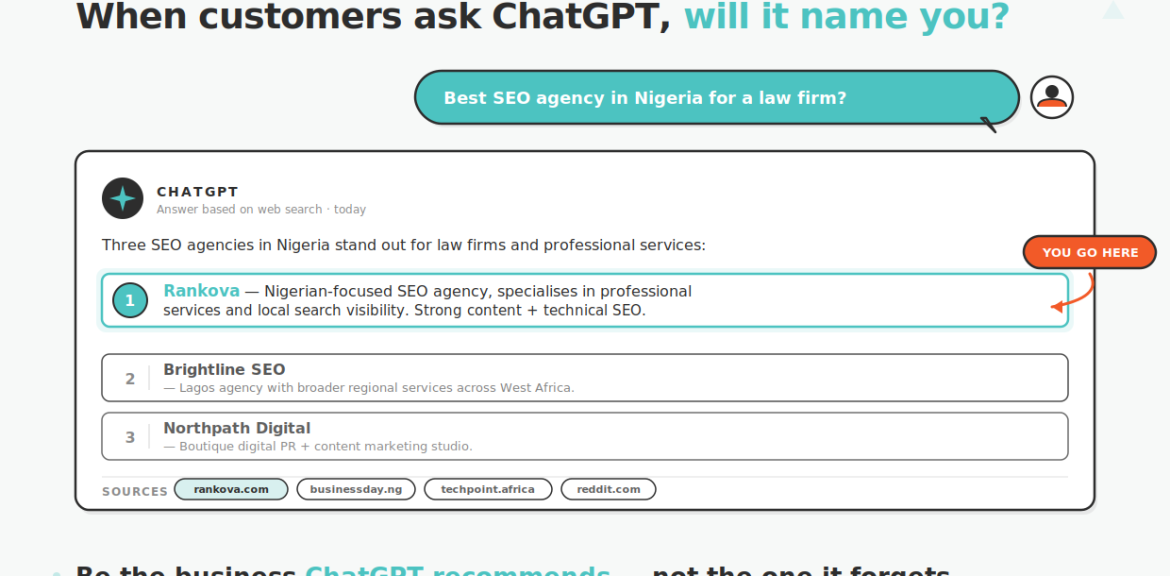
Right now, somewhere in Lagos, a potential customer is typing this into ChatGPT:
Or this:
“Top dental clinics in Lekki.”
ChatGPT will return a confident, conversational answer. It will name two or three businesses but won’t show ten blue links. It won’t show ads. And the businesses it names will get the lead.
If your business isn’t in that answer, you don’t exist to that customer.
This isn’t a future trend. In 2026, ChatGPT handles over 2 billion queries every day. Google’s AI Overviews now appear in roughly 16% of all searches. And here’s the part that should change how you think about this: traffic from AI tools converts dramatically better than regular Google traffic — by some measurements, 20+ times better. Showing up in ChatGPT isn’t just about exposure. It’s about getting in front of customers who are already ready to buy.
This is the playbook to get there.
Wait — isn’t this just SEO?
Sort of. The discipline has a name now: Generative Engine Optimization (GEO), sometimes called Answer Engine Optimization (AEO). Same thing — structuring your content and brand so AI systems pick you as a source when generating answers.
But three things are different from traditional SEO:
1. You’re not optimizing for clicks. You’re optimizing to be recommended. When ChatGPT answers “best dentist in Victoria Island,” the user often doesn’t click any link. They just trust the answer. Your win is being named.
2. The signals that matter have shifted. Keywords and backlinks still help. But fact density, entity clarity, and how often your brand is mentioned across the open web now matter more.
3. There’s no page 2. In traditional Google, page 2 still gets some traffic. In ChatGPT, you’re either in the answer or you’re invisible. There’s no middle ground.
How ChatGPT actually picks what to cite
ChatGPT pulls from two places:
- Its training data — everything it learned during model training, including pages crawled by OpenAI’s web crawler (GPTBot).
- Live web search — for current questions, ChatGPT runs a Bing-powered search and reads the top results in real time.
When it constructs an answer, it scans those sources and prefers content that:
- Answers the question directly in the first one or two sentences
- Cites real, verifiable data (statistics, dates, named comparisons)
- Comes from a source the model already trusts (industry publications, Reddit, LinkedIn, Wikipedia)
- Has clean, well-structured headings that match how people actually ask questions
- Is technically simple — readable HTML, not buried in JavaScript or images
The Princeton “GEO” study — the foundational research on this topic — found that adding cited statistics to content increased AI citation rates by up to 40%.
In other words: AI engines prefer content that proves things, not content that just claims them.
7 steps to get cited in AI answers
1. Audit where you stand today
Before anything else, find out the truth. Open ChatGPT, Perplexity, Claude, and Google AI Mode. Type the questions your customers actually ask:
- “Best [your industry] in Lagos”
- “How much does [your service] cost in Nigeria”
- “[Competitor name] vs alternatives”
For each, write down:
- Does your business appear?
- If not, which businesses do?
- Which pages are the AI tools citing as sources?
This is your baseline. You can’t improve what you can’t measure.
2. Restructure your most important pages — answer first
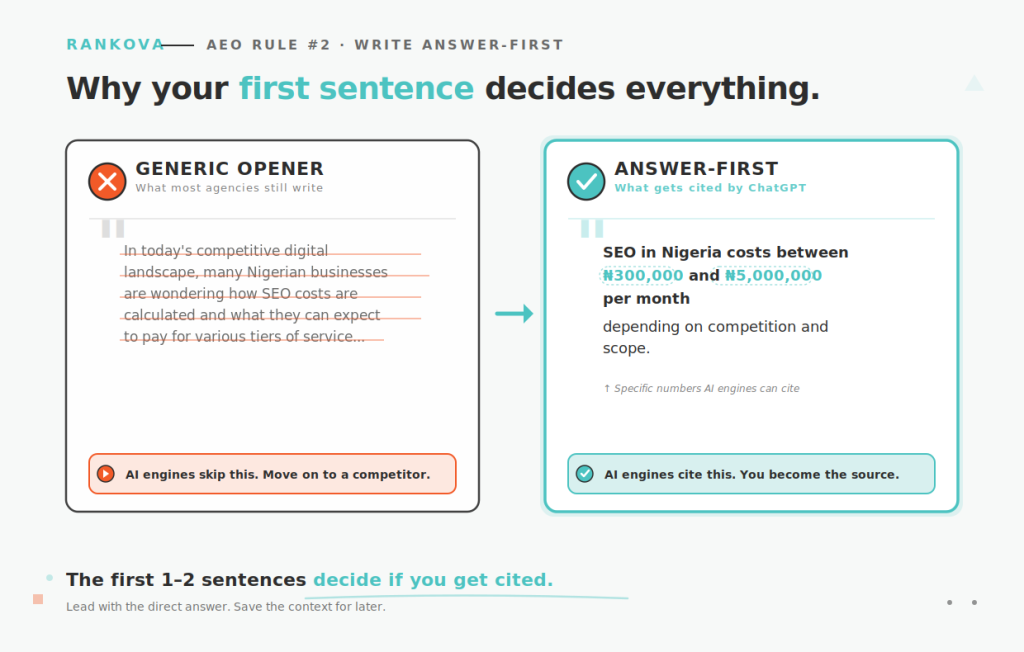
This is the single biggest on-page change you can make. The first one or two sentences of every section should directly answer the question implied by the heading.
Don’t do this:
“In today’s competitive digital landscape, many Nigerian businesses are wondering how SEO costs are calculated and what they can expect to pay for various tiers of service…”
Do this:
“SEO in Nigeria costs between ₦300,000 and ₦5,000,000 per month depending on competition and scope. Here’s what each tier includes…”
AI engines read those first sentences and decide if your page answers the question. Vague openings get skipped.
3. Pack in fact density
This is the Princeton finding made practical. Every 150–200 words, include a specific, verifiable fact:
- A number with context: “We’ve ranked 47 Nigerian businesses on page 1 of Google in the last 18 months.”
- A statistic with a source: “According to NBS data, Nigeria has over 41 million MSMEs.”
- A quote from a real person, with their name and role
- A date, percentage, or named comparison
The phrases to avoid: “many,” “a lot,” “extensive experience,” “industry-leading.” These don’t get cited because they don’t actually say anything. AI models prefer claims they can verify.
4. Build your brand entity across the open web
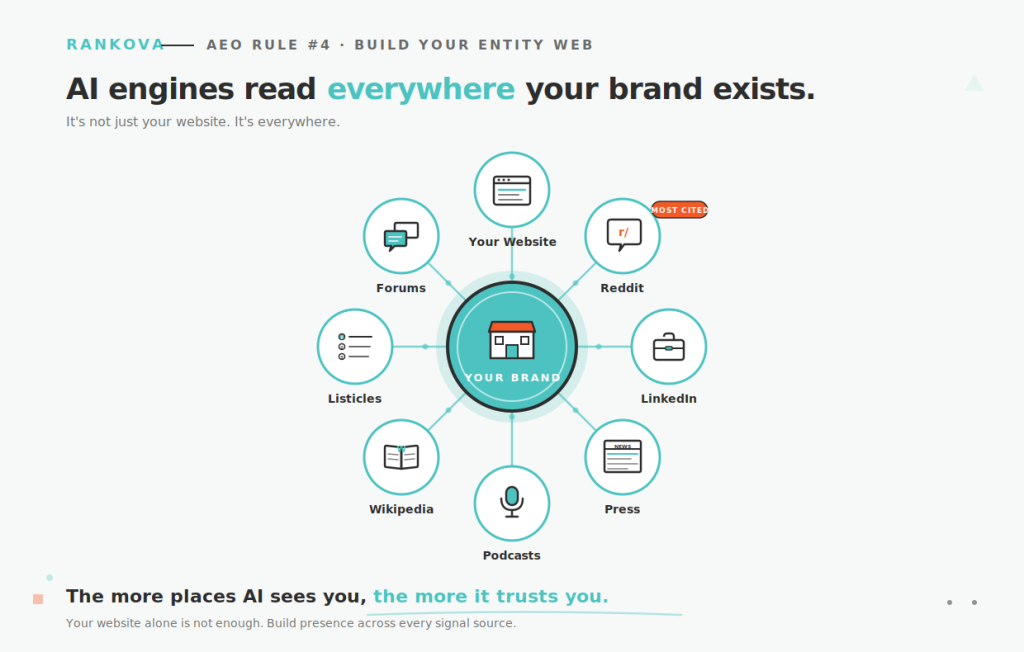
This is the part most Nigerian businesses skip. ChatGPT doesn’t just read your website — it reads everywhere your business is mentioned. The more places it sees you, the more confident it becomes that you exist and that you matter.
The high-leverage places in 2026:
- Reddit — by far the most cited platform across all AI engines, according to Semrush data from January 2026. Find subreddits where your customers ask questions and contribute genuinely helpful answers. Don’t promote. Just be useful.
- LinkedIn — especially for B2B and professional services. Publish thoughtful posts. Engage in industry discussions.
- Wikipedia — if your brand qualifies (independent media coverage), get a page.
- Industry roundup articles — get listed in “Top SEO agencies in Nigeria”-style articles. These get cited heavily by AI engines.
- Podcasts and interviews — being named on a podcast with a published transcript creates a citable mention.
- Press mentions — get covered by Techpoint Africa, Business Day, Nairametrics, TechCabal, and similar outlets.
5. Add structured data (schema markup)
This is technical but important. Schema markup is code on your website that tells AI engines exactly what your content is: an article, an FAQ, a business, a person.
The schemas that matter most for AEO:
Organizationschema on your homepage (who you are)Articleschema on every blog postFAQPageschema for question-and-answer sectionsLocalBusinessschema if you serve a specific areaPersonschema for author bios
If your current SEO setup doesn’t include these, that’s a red flag. At Rankova, we audit and implement these as part of every standard onboarding.
6. Add FAQ sections to your service pages
This single tactic earns disproportionate citations. At the bottom of every important service page, add 5–8 questions your customers actually ask — with clear, direct answers.
How to find the right questions:
- Ask your sales team what prospects keep asking
- Check “People Also Ask” boxes on Google for your main keywords
- Look at autocomplete suggestions on Google and YouTube
- Read Reddit threads and Quora answers in your niche
Format matters too: use a proper question structure (“How long does SEO take in Nigeria?”), then a direct one-or-two-sentence answer, then optional context.
7. Make sure AI can actually read your site
This is the fastest fix most businesses miss. AI crawlers prefer simple, fast-loading HTML. They struggle with:
- Content that only loads after JavaScript executes
- Text trapped inside images
- Important information locked behind PDFs
- Pages that don’t load in under three seconds
- Sites that block GPTBot in
robots.txt(check yours right now)
Open your site in a browser with JavaScript disabled. Can you still see all the important content? If not, AI engines probably can’t either.
How long until you see results?
Realistically, three to six months — similar to traditional SEO. Early signals usually show up within six to eight weeks: your brand starts appearing in answers to less competitive queries, your citation rate for niche prompts climbs, and you may see referral traffic from chatgpt.com or perplexity.ai in your analytics for the first time.
The deeper wins — being cited for high-intent, competitive queries like “best SEO agency in Lagos“ — take longer. Those require the brand-building work outside your website: the Reddit presence, the press mentions, the podcast appearances, the listicle placements.
If you’re already strong in traditional SEO, you have a head start. Pages that already rank in Google’s top 10 are heavily favoured by AI engines as citation sources.
What to measure
Forget rankings as your main metric. The new KPIs:
- Citation rate — what percentage of your priority prompts include a mention of your brand
- Share of Answer — your citation rate compared to competitors for the same prompts
- AI referral traffic — visitors arriving from
chatgpt.com,perplexity.ai,claude.ai, etc. (visible in your Google Analytics under referral sources) - Branded search lift — when AI citations are working, your branded Google search volume rises because people who see you cited then search for you directly
Track these monthly. Compare quarter over quarter.
The window is closing
Here’s the part nobody wants to say out loud: most Nigerian businesses are doing zero GEO work right now. Their websites still open every section with “In today’s competitive landscape…” Their service pages still have vague “we have extensive experience” copy. They have no presence on Reddit. They have no schema markup. They’ve never once tested whether ChatGPT mentions them.
This means the businesses that start now have an enormous first-mover advantage. The competitive set in Nigerian AI answers is still small. Owning the citation slot for “best SEO agency in Nigeria” or “top dental clinic in Lekki” is available right now in a way it isn’t on Google.
But by mid-to-late 2026, this will change. Every category will fill up. The brands that have spent six to twelve months building authority in AI answers will be the ones cited. Latecomers will be invisible — and unlike Google SEO, there’s no shortcut to claw your way back in.
Where Rankova fits
We help Nigerian businesses dominate both traditional Google search and AI-generated answers. Every Rankova SEO package in 2026 includes GEO/AEO as a standard component: prompt audits, answer-first content rewrites, schema implementation, entity building across Reddit and LinkedIn, and quarterly citation tracking across ChatGPT, Perplexity, Claude, and Google AI Mode.
Want to know how often your business currently appears in ChatGPT answers — and exactly what’s costing you citations?
Book a free AI Visibility Audit →
We’ll run your top 30 customer queries through every major AI engine, show you where you stand against competitors, and give you a 90-day roadmap to start getting cited.
Pingback:Best AEO Agency for Law Firms: Your Competitive Edge - SEO & AI Search Optimization Agency
Pingback:The Best SEO Agency for E-commerce and Shopify Stores - SEO & AI Search Optimization Agency
Pingback:Questions to Ask Before Hiring an SEO Agency - SEO & AI Search Optimization Agency
Pingback:What to Expect in the First 90 Days with an SEO Agency - SEO & AI Search Optimization Agency
Pingback:Local SEO for Small Businesses in Nigeria: A Practical No-Budget Guide. - SEO & AI Search Optimization Agency
Pingback:What Is Schema Markup? A Plain-English Guide for Business Owners - SEO & AI Search Optimization Agency