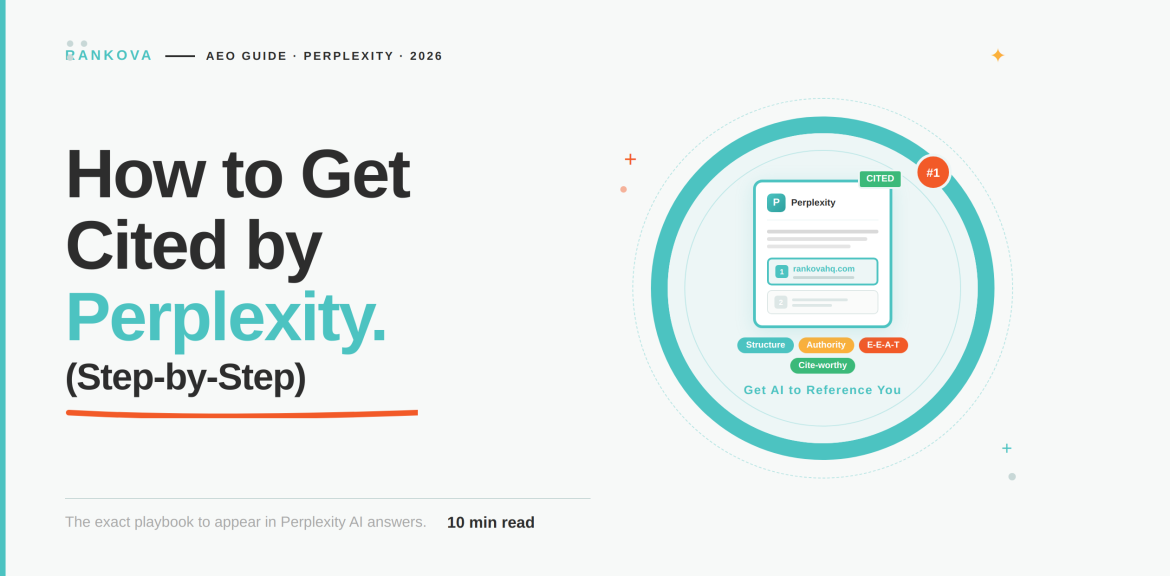
Perplexity AI now handles over 100 million queries every month. When someone asks Perplexity a question about your product category, your service type, or your area of expertise, it visits roughly ten web pages, selects three or four of them as sources, and builds its answer from those. The sources it selects will appear as numbered citations directly beneath the answer, visible to every reader. The big question is, how can one get cited by Perplexity?
Before we answer that, one must know that most customers on Perplexity are ready to buy. To these potential customers, the businesses that aren’t appearing don’t exist in that moment, regardless of how good their product is, or how much they’ve spent on ads, or how well they rank on Google.
That’s why your business needs to be on Perplexity. This guide explains exactly how to become one of the sources Perplexity selects. It covers how Perplexity’s selection process works, what separates cited content from visited yet discarded content, and the specific actions that move your brand from invisible to recommended. Let’s get into it.
Quick Answer: How Do You Get Cited by Perplexity?
You need to do three things simultaneously;
- Make your content technically accessible to Perplexity’s crawler.
- Structure it so Perplexity can extract clean answers from it.
- Build enough authority that Perplexity trusts your brand enough to recommend it.
The steps below cover all three layers in order of impact.
How Perplexity Selects Its Sources
Before the steps, you need to understand the selection process because it explains why some optimizations matter far more than others. Perplexity is an answer engine and not a search engine. The distinction helps to understand how it selects content.
When an individual/user asks Perplexity a question, the platform does not return a list of ranked results and let the user decide. Rather, it visits approximately ten web pages, reads them, extracts the most relevant passages, synthesizes those into a single answer, and cites three to four sources for the user.
That ratio (ten visited, and three or four cited) is the central fact of Perplexity optimization. Your content is not competing to rank in a list of ten. It is competing to survive a selection process where it has read six or seven pages.
So, how does Perplexity decide which pages survive that selection? They use the following four criteria:
- Direct relevance.
Does the page answer the specific question asked? This answer should not be a general topic, but should provide the exact answer to the question. Perplexity decomposes complex queries into multiple sub-questions and evaluates pages against each one. It may visit a page about “SEO for SaaS companies” when someone asks “which SEO agencies specialise in SaaS?” but discard it because they never directly answer the specific question.
- Extractability.
Can Perplexity lift a self-contained answer from the page without needing the surrounding context to make sense of it? Pages that bury answers in long paragraphs, or that rely on context from earlier sections, are harder to extract from. Hence, it is easier for Perplexity to discard them in favour of pages that answer questions in the first sentence of each section.
- Domain authority.
Does Perplexity recognise the source as credible? You should know that there is no strong citation for new sites, thin sites, and sites. The reason is that they have no external validation; hence, they have far less authority than established brands with a consistent presence across multiple platforms. While this is not primarily about domain authority scores, it’s rather about whether Perplexity’s training data has encountered your brand as a trustworthy source across multiple contexts.
- Freshness.
Is the content current?
Perplexity regards recency more than almost any other AI platform. A well-structured page published last month will consistently beat an identical page published two years ago with no updates. For topics where conditions change, Perplexity may penalise outdated content.
Now let’s get to the steps that show your business on Perplexity;
Step 1: Make Sure Perplexity Can Actually Find You
This addresses technical accessibility, the prerequisite for everything else.
Perplexity cannot cite content it cannot read. Before any content or authority work, verify that Perplexity’s crawler (called PerplexityBot) has access to your site.
Check your robots.txt file (accessible at yourdomain.com/robots.txt) and confirm it does not block PerplexityBot. Many sites have set up broad crawler-blocking rules years ago and inadvertently prevent AI crawlers from accessing content that would otherwise rank well.
Your robots.txt should explicitly allow the major AI crawlers. You should also check to see;
- That your key pages load quickly
- And that they are accessible without JavaScript being required for the content to appear.
- That they’re properly indexed.
Perplexity’s crawler has limited patience for slow or technically complex pages.
Step 2: Create an llms.txt File
This helps Perplexity understand your site’s structure and priority content.
An llms.txt file is a plain-text document that tells AI systems what your website is about and which pages are most important. You can think of it as a sitemap designed specifically for AI crawlers rather than traditional search engines.
This is one of the fastest high-impact changes you can make. Most websites don’t have it. Creating it puts you ahead of the majority of competitors in your category immediately.
Step 3: Add Structured Data to Your Key Pages
Structured data helps Perplexity to go through and extract your content reliably.
Structured data (also called schema markup) is code that labels the content on your page so AI systems can understand the article title, the author, the questions and answers in your FAQ, and the steps in a how-to guide.
Research shows that sites using structured data are cited by AI platforms 3.2 times more often than those without it. The FAQPage schema correlates with a 28–40% higher AI citation probability because it packages questions and their answers in a format AI retrieval systems are built to extract directly.
The schema types that matter most for Perplexity citations:
- Article schema
- FAQPage schema
- HowTo schema.
- Organization schema.
Step 4: Rewrite Your Content for Extraction
This is the step that makes the biggest difference for most sites, and it requires no technical changes at all. It’s purely about how you write your content.
Perplexity doesn’t read your articles the way a human does. It scans for self-contained passages that it can lift cleanly and use in a synthesized answer. If the answer to a question is buried in paragraph four or requires reading paragraphs one through three to understand, Perplexity will move on to a page that answers the question in the first sentence.
The principle is called answer-first writing.
You should open every major section with a direct answer to the question the heading implies. Keep that opening to 40–60 words. Follow with supporting evidence, detail, and context.
Step 5: Build the Off-Site Signals Perplexity Needs to Trust You
Perplexity doesn’t just evaluate the page in front of it but also evaluates the source. A technically structured page from a brand Perplexity has never encountered across multiple contexts will still lose to a decent page from a brand it has encountered repeatedly and learned to associate with expertise.
Hence, off-site presence is critical. You should also know that 46.7% of Perplexity’s top citations come from community platforms like Reddit and Quora. Perplexity uses these platforms as consensus signals. If the same information from your brand appears on your site, in a Reddit thread, on LinkedIn, and in an industry publication, Perplexity treats the information as more reliable than if it appears only on your own site.
The most effective off-site channels for Perplexity authority:
- Reddit and niche communities.
- LinkedIn.
- Industry publications and mentions.
- Consistent brand presence across directories and platforms.
Step 6: Publish and Update Content Consistently
You should also know that Perplexity prioritises content freshness over almost any other AI platform. So, a well-structured and authoritative article published recently will consistently beat an equally well-structured article published two years ago with no updates.
This matters especially for topics like market trends, pricing, best practices, regulatory changes, and platform features. Content that was accurate in 2023 may still be accurate today, but Perplexity’s freshness weighting will deprioritise it in favour of something published or updated recently.
Hence, you should update your most important pages at least quarterly. Add current data, update examples, and refresh any time-sensitive information. Change the published date when you do, and Perplexity reads publication dates as a direct freshness signal.
Publish on trending topics in your industry quickly. If something significant happens in your sector, a well-structured page covering it, published within days of the event, will accumulate Perplexity citations while competitors are still drafting their responses.
Step 7: Track Whether It’s Working
Perplexity citation tracking is less mature than traditional SEO tracking, but the signals are there if you know where to look. Hence, you should track if it’s working by;
- Check your referral traffic.
- Search manually and regularly.
- Check server logs for PerplexityBot activity.
- Monitor branded search volume
- Use AI visibility monitoring tools.
Frequently Asked Questions About How to Get Cited by Perplexity.
Here are some of the frequently asked questions about how to get cited by Perplexity;
Question 1: What is Perplexity AI?
Perplexity AI is a conversational answer engine that performs a web search for every query, synthesizes information from multiple sources, and cites those sources directly in its answer. It handles over 100 million queries per month and is one of the fastest-growing AI search platforms.
Question 2: How does Perplexity choose which sources to cite?
Perplexity visits approximately ten web pages per query and selects three to four to cite based on certain criteria.
Question 3: How long does it take to get cited by Perplexity?
Perplexity indexes new content significantly faster than Google. However, PerplexityBot has access to your site. After implementing the steps in this guide, most businesses begin seeing their first Perplexity citations within two to four weeks.
Question 4: Does Perplexity citation require technical SEO expertise?
The foundational steps require some technical familiarity but can be done without developer expertise on most modern CMS platforms. The content restructuring steps do not need any technical knowledge at all and often have the most immediate impact.
Question 5: How is getting cited by Perplexity different from ranking on Google?
Google ranks pages in order of relevance and authority, giving users a list to choose from. Perplexity selects a small number of pages, synthesizes an answer, and recommends those sources directly.
Question 6: Can small businesses get cited by Perplexity?
Yes. Perplexity’s citation selection is less dominated by large, authoritative domains than Google’s traditional rankings. A small business with well-structured, genuinely relevant, and recently updated content can and does appear in Perplexity citations alongside much larger competitors.
Question 7: What is AEO, and how does it relate to Perplexity citation?
AEO (Answer Engine Optimization) is the discipline of optimising content and brand presence for AI-powered answer platforms like Perplexity, ChatGPT, Google AI Overviews, and others.
Conclusion
The steps in this guide work, but they work best when they are part of an ongoing strategy rather than a one-time technical exercise.
Getting cited by Perplexity once is the result of good content and good technical setup. Getting cited consistently is the result of a compounding authority strategy that builds over months. Hence, you need content that answers the questions your buyers are asking, a brand presence that appears consistently across platforms, and a publishing rhythm that keeps your content fresh.
Don’t forget to track to know what’s working and where to double down. That is the difference between appearing in an AI answer occasionally and becoming the brand that AI systems will always recommend by default in your category.
Rankova builds AEO and SEO strategies for SaaS and B2B tech companies, real estate agencies, and e-commerce brands. If you want to rank on Perplexity and other AI platforms, Rankova offers a free audit for your brand. That’s where great conversations start.
Book your free audit with Rankova.
To learn more, read here;
How to Tell if Your SEO Agency Is Actually Working
How Long Does SEO Actually Take? A Realistic Timeline for Nigerian Businesses
How Much Does SEO Cost in Nigeria? (2026 Breakdown)
SEO vs Paid Ads: Which One Actually Makes More Money? – SEO & AI Search Optimization Agency
Best SEO Agency for Law Firms in Nigeria
How to Make Your Business Show Up in ChatGPT Answers
Rankova | Best SEO Company in Nigeria for Real Growth
How to Tell if Your SEO Agency Is Actually Working (or Just Sending Reports) | Rankova
7 SEO Mistakes That Are Killing Your Website Traffic in 2026 – SEO & AI Search Optimization Agency
How Long Does SEO Actually Take? A Realistic Timeline for Nigerian Businesses | Rankova
Why Your Website Isn’t Getting Sales (And How SEO Fixes It) – SEO & AI Search Optimization Agency
Pingback:What Is Answer Engine Optimization? A Complete Guide for Business Owners. - SEO & AI Search Optimization Agency
Pingback:How to Write a Blog Post That Ranks on Google - SEO & AI Search Optimization Agency
Pingback:Local SEO for Small Businesses in Nigeria: A Practical No-Budget Guide. - SEO & AI Search Optimization Agency