Do you want to hire an SEO agency, or are you thinking about it? The first question on your mind would probably be: How long does SEO take before I see results?
Well, while some agencies say 3 months, others say 6 months. The height of uncertainty is worse for some businesses, as they leave the call knowing nothing. However, a few agencies will promise you page one rankings in 30 days, which should immediately make you close the tab.
This article clears all doubts by answering the question. The honest answer covers what the timeline looks like for Nigerian businesses specifically, what affects how fast you see results, and what you should be seeing at each stage if your SEO is actually working.
How long does SEO take for a Nigerian business? Let’s get into it.
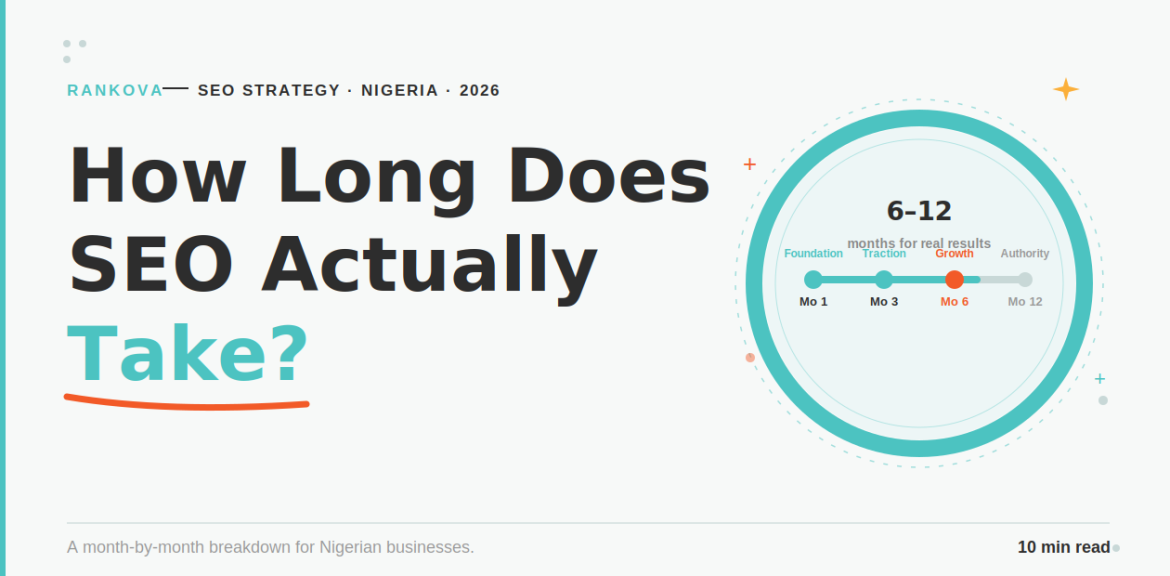
The Honest Answer: 6 to 12 Months for Real, Compounding Results
Not what you wanted to hear. But here’s why it’s the truth — and why understanding it will save you from making expensive mistakes.
SEO is not advertising. When you run a Google Ad, you pay, you appear, you get clicks. The moment you stop paying, you disappear. SEO works the opposite way — it builds an asset. That asset takes time to construct, but once it exists, it works for you continuously without ongoing spend per click.
The 6–12 month timeline reflects how Google actually works:
- Google needs to discover your content, crawl it, index it, and evaluate it against hundreds of ranking signals
- New or updated pages go through a period of ranking volatility before settling
- Backlinks take time to be discovered and to pass authority
- Google’s trust in a domain increases gradually, not overnight
None of this can be hacked or rushed — not sustainably, anyway.
Why the Timeline Is Slightly Different for Nigerian Businesses
The 6–12 month benchmark is global. For Nigerian businesses, a few factors can push you toward the faster or slower end of that range.
Factors that can speed things up:
- Lower local competition — if you’re targeting Nigerian-specific searches (“best logistics company in Lagos,” “HR software Nigeria”), the competition is often significantly lighter than US or UK equivalents. Less competition means faster ranking movement.
- Underserved content gaps — many Nigerian industries have almost no quality content targeting local search intent. If you’re the first to create genuinely useful content in your niche for a Nigerian audience, you can rank quickly.
- Mobile-first opportunity — most Nigerian users search on mobile. If your site is technically clean and fast on mobile while your competitors aren’t, that’s a meaningful advantage Google rewards.
Factors that can slow things down:
- New domain with no history — if your website is less than a year old, Google treats it with extra caution regardless of how good your content is. This is sometimes called the “Google Sandbox” effect. It’s real, and it’s not negotiable.
- Poor technical foundation — slow load times (extremely common with Nigerian websites hosted on cheap shared servers), crawl errors, and mobile usability issues all slow ranking progress
- Previous SEO damage — if a previous agency built spammy links or used black-hat tactics, you may be working from a deficit. Recovery takes longer than starting fresh.
- Highly competitive industries — fintech, real estate, and e-commerce in Nigeria are increasingly competitive. The more established players are ahead, the longer it takes to overtake them.
Month-by-Month: What Should Actually Be Happening
This is the timeline we work to at Rankova, and what you should hold any serious agency accountable to.
Month 1 — Foundation
This month is almost entirely invisible from a rankings perspective, which is why impatient clients sometimes panic. But this is where the most important work happens.
What should be completed:
- Full technical audit with prioritized fixes
- Keyword research and search intent mapping
- Competitor gap analysis — who is outranking you and on which queries
- Content architecture plan — what to build and in what order
- On-page optimization of your highest-priority existing pages
- Google Search Console and Analytics properly configured and verified
- Baseline rankings documented so progress can be measured
What you should NOT expect: meaningful ranking changes. Pages don’t move in the first month. If an agency is showing you big ranking gains in month one, ask hard questions about what tactics they used.
Recommended: How to Rank Your Business on Google Maps in Lagos
Month 2–3 — Early Signals
Google starts to notice the changes made in month one. Technical fixes reduce crawl errors and improve indexation. Optimized pages begin to show movement — usually not dramatic, but measurable.
What should be happening:
- Technical fixes implemented and confirmed resolved in Search Console
- First pieces of new content published and indexed
- Initial link building outreach underway
- Rankings on target keywords beginning to shift, mostly from positions 30–50 moving to 15–30
- Organic impressions in Search Console increasing even if clicks haven’t followed yet
Things your reports should show:
- Crawl error reduction
- Index coverage improvement
- Keyword position movement (upward trend, not necessarily page one yet)
- Organic impressions graph trending up
What this means in plain terms: you’re climbing from the pages nobody looks at toward the pages people might actually find you on. This is real progress even if it doesn’t feel dramatic yet.
Month 4–6 — Traction
This is the phase where SEO starts to feel real. If the first three months were done properly, you’ll begin to see organic traffic that wasn’t there before. Not flood-the-inbox levels yet — but demonstrable, attributable traffic from search.
What should be happening:
- Multiple pieces of content ranking on page 2 and beginning to push toward page 1
- Some keywords reaching page 1 for the first time (typically lower-competition, long-tail terms first)
- Backlinks beginning to accumulate and pass authority
- Organic traffic showing a clear upward trend vs. baseline
- Some leads or conversions beginning to come from organic search
What Nigerian businesses typically experience in this phase:
- Local terms (“your service + Lagos/Abuja/Port Harcourt”) often hit page 1 first
- Blog content starts generating impressions on informational queries
- Branded search volume often increases as overall visibility rises
This is also the phase where the compounding nature of SEO becomes visible. Pages that rank start earning more links. More links push rankings higher. Higher rankings drive more traffic. The flywheel starts spinning.
Month 6–9 — Compounding Growth
If you’ve been doing this properly, month six to nine is when SEO becomes hard to argue with internally. Traffic is clearly up. You can point to specific pages, specific keywords, and specific traffic numbers that weren’t there six months ago.
What should be happening:
- Core service and product pages ranking on page 1 for primary keywords
- Organic traffic contributing meaningfully to overall lead volume
- Content pieces beginning to earn links organically (people finding and linking to your content without outreach)
- Branded search queries increasing — more people searching for Rankova or your company name specifically
- Clear ROI beginning to emerge when you calculate organic traffic value vs. retainer cost
Month 9–12 — Authority
By month 9–12 of consistent, quality SEO, a well-executed campaign should have transformed your search presence materially. You’re no longer a new entrant — Google has established trust in your domain.
What you should have by month 12:
- Stable page 1 rankings for your core commercial keywords
- A content library that continues to drive traffic and earn links
- A domain authority profile that makes future ranking significantly easier and faster
- Organic search as a reliable, measurable lead generation channel
- A clear picture of which content types and keywords drive the most revenue
The Most Common Reason SEO “Doesn’t Work” in Nigeria
Before we go further, let’s address the elephant in the room. Many Nigerian business owners have tried SEO and feel burned. Here’s what usually went wrong:
They stopped too early. The most common mistake is hiring an agency for three or four months, seeing limited visible results, and concluding that SEO doesn’t work. Month four is right in the middle of the traction phase — close enough to results that stopping there is like getting off a flight one hour before landing.
They hired the wrong agency. Template keyword lists, generic blog posts, and directory links don’t build real authority. Many Nigerian businesses paid for the appearance of SEO without receiving the substance of it.
Their site had unfixed technical problems. You can produce excellent content on a website Google can’t properly crawl, and rank nowhere. Technical SEO is the foundation — without it, everything built on top is compromised.
They didn’t give Google enough to work with. Thin sites with five pages and no content don’t rank. SEO requires a minimum viable content base before the algorithms have enough to evaluate.
Recommended: Why Do SEO Agencies Charge $1,000 vs $10,000?
What a Realistic 12-Month Projection Looks Like
Here’s an illustrative example based on a Nigerian B2B services business starting from scratch with a relatively new domain:
| Month | Primary Keyword Positions | Organic Traffic (monthly) | Leads from Organic |
|---|---|---|---|
| 1 | 50–80 | Near zero | 0 |
| 3 | 20–40 | 50–150 visits | 0–2 |
| 6 | 8–20 | 300–800 visits | 5–15 |
| 9 | 4–12 | 800–2,000 visits | 15–40 |
| 12 | 1–5 | 2,000–6,000 visits | 40–120 |
These are not guarantees — every market, domain, and competitive landscape is different. But they give you a realistic anchor for what compounding SEO growth actually looks like.
Frequently Asked Questions About How Long Does SEO Take?
Hold your agency accountable with these specific questions:
Question 1: What milestones should I expect to see by month three, six, and twelve?
If they can’t give you specifics, they’re not confident in their plan.
Question 2: What’s the search demand for my primary keywords, and what does realistic traffic look like if I reach page one?
This tells you whether the effort is worth it before you commit.
Question 3: How will we measure progress beyond rankings?
Rankings are a leading indicator — traffic and leads are what actually matter.
Question 4: What would cause us to revise the timeline, and how would you communicate that?
Good agencies track actual vs. projected and explain deviations.
Question 5: Can you show me a timeline from a client in a similar situation to ours?
Real case evidence beats theoretical projections.
The Rankova Perspective
At Rankova, we give every client a specific 12-month projection before they sign. This includes keyword tiers, traffic estimates, and lead volume. That way, their expectations are calibrated from day one.
We don’t promise timelines we can’t defend, and we don’t hide behind vague language when a month goes slower than expected. SEO takes time, but it should never feel like a black box.
If you want to understand what a realistic SEO timeline looks like for your specific business, we will map it out in a free strategy session before you spend a naira.
Book your free SEO timeline review with Rankova →
The Bottom Line: How Long Does SEO Take?
SEO takes 6–12 months to deliver meaningful, compounding results. That’s not a hedge — it’s the honest reality of how Google works and how authority is built.
For Nigerian businesses, the opportunity is real: lower competition on local searches, underserved content gaps, and a growing internet user base that increasingly searches before it buys. The businesses that invest in SEO consistently today will own those search results for years.
Start now, set realistic expectations, hire the right agency, and give it the time it needs. The compounding math is on your side.
Want to understand where your site stands today and what a realistic 12-month SEO journey looks like for your business? Book a free strategy call with Rankova.
Pingback:Best SEO Agency for Law Firms in Nigeria - SEO & AI Search Optimization Agency
Pingback:Best SEO Agency for SaaS and B2B Tech - SEO & AI Search Optimization Agency
Pingback:Best SEO Agency for Real Estate - SEO & AI Search Optimization Agency
Pingback:Best AEO agency for Home Services (HVAC, Plumbing, Contractors). - SEO & AI Search Optimization Agency
Pingback:How to Measure ROI on SEO and AEO Services - SEO & AI Search Optimization Agency
Pingback:What to Expect in the First 90 Days with an SEO Agency - SEO & AI Search Optimization Agency
Pingback:How to Get Cited by Perplexity (Step-By-Step) - SEO & AI Search Optimization Agency
Pingback:SEO Contracts Explained: What Should and Shouldn't Be in Yours - SEO & AI Search Optimization Agency
Pingback:How to Tell if Your SEO Agency Is Actually Working (or Just Sending Reports) | Rankova