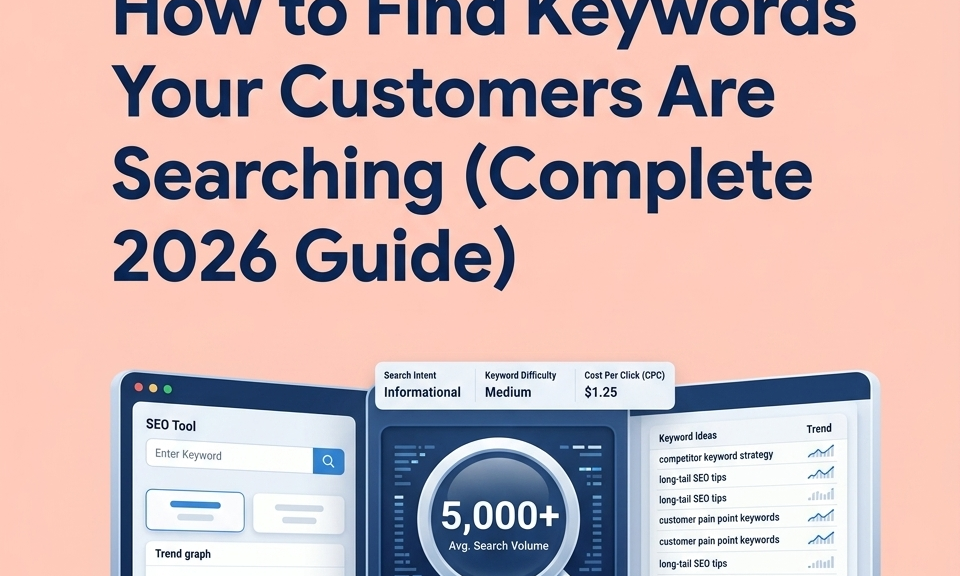
If your website is not bringing in customers, there is a high chance you are targeting the wrong keywords. You need to know how to find keywords your customers are searching for.
This is not because your business is not valuable, or because SEO does not work. Rather, it is because you are optimizing for what you think people search, not what they actually type into Google.
Keyword research is no longer about chasing popular terms but about understanding search intent and aligning your content with your customer behavior. Hence, you must act like a customer to know how a customer would behave.
This article will show you how to find the exact keywords your customers are searching for using practical methods, free tools, and insights that perfectly suit your business in a competitive digital space. It also ends with a major tip that most businesses in Nigeria are completely missing.
Quick Answer: How to Find Keywords Your Customers Are Searching.
Here are ways to find keywords your customers are searching for.
- Identify your core products or services (seed keywords).
- Use Google Autocomplete to discover the most-used search phrases.
- Validate keywords with tools like Google Keyword Planner.
- Focus on long-tail keywords with clear intent.
- Analyze competitors to find proven opportunities.
- Prioritize keywords based on intent and conversion potential.
Let’s get right into the article.
What Are Keywords?
Keywords are the words and phrases people type into search engines when they are looking for something. It is how customers express their curiosity and communicate what they need to know if a business can offer the same.
For example, if someone types “affordable SEO agency in Lagos” into Google, every word in that sentence is a keyword signal. When a shop owner in Ibadan types “how do I get more customers from Google,” that entire phrase is a keyword.
Google reads these signals and decides which websites deserve to show up. However, a common mistake most businesses make is that they chase the words they would use to describe their business and not the words their customers actually type.
That gap is where most Nigerian businesses lose the SEO game before it even starts.
Where Most Businesses Go Wrong – How They Find Keywords.
At this point, most businesses make a costly assumption that the job is done when they have a list of keywords. That is not true. What starategy did they use to find keywords?
The difference between a keyword that brings traffic and one that brings paying customers is not obvious on the surface. Two keywords can have similar search volume but completely different business outcomes. Without the right interpretation, it is easy to spend months creating content that ranks but never brings in a single paying customer.
So, what is the solution to find keywords?
Why Keyword Research Is Non-Negotiable in 2026
Google processes approximately 99,000 searches per second, which is roughly 8.5 billion per day. Every search represents someone looking for an answer, a product, or a service.
The question is: is your business showing up for the ones that matter?
According to statistics, long-tail keywords (phrases of three or more words) account for 70–92% of all search traffic and consistently convert better than short keywords. Research also shows that shorter keywords convert far less than longer, more specific queries.
For small and medium-sized businesses in Nigeria, this changes everything.
You do not need to compete with global brands for expensive, broad keywords. Rather, you need to win the specific, high-intent searches your ideal customers are already making. You need to find the right keywords.
See the process your business needs below;
Step 1: Understand Search Intent Before You Find Keywords.
Search intent is the why behind a search. It is the reason someone is typing those words in the first place. In 2026, Google prioritizes content that matches intent and not just content that includes keywords.
There are four types of content and their examples:
- Informational — “What is SEO?”
- Navigational — “Rankova SEO agency Lagos.”
- Commercial — “Best SEO agency in Nigeria 2026.”
- Transactional — “Hire SEO expert for small business in Nigeria.”
As a business, you must note that the value lies in commercial and transactional keywords. You must target such keywords to increase traffic that leads to conversion.
Step 2: Start With Seed Keywords
What is a seed keyword? A seed keyword is a simple phrase that describes your core business.
Also, it is advisable to include location in your seed keywords because it improves your visibility to people in your region. On the flip side, it also improves credibility because you have an actual place customers can relate to.
See examples below:
- A fashion brand can use “women’s clothing Nigeria,” or “Ankara dresses Lagos.”
- A logistics company can use “delivery services Abuja,” or “same day courier Nigeria” as their seed keywords.
These seed keywords mean that if a customer types any of these sets of words, you want them to be directed to your business. However, these are your starting points and not your final targets.
Step 3: Use Free Tools to Expand Your Keyword List
Another thing many businesses get wrong is that they think you need expensive tools to get started. No, you don’t. Here are some free tools to expand your keyword list;
- Google Autocomplete
When you open Google, type your keyword and observe the suggested words. Those phrases are the result of customers’ searches. You can always observe these under the People also ask and Related searches sections.
Sometimes, these sections may come as questions. Use those phrases and questions to expand your keyword list that is relevant to your business.
- Google Keyword Planner
This shows two things;
- Search volume
- Competition level
Here is a free tip: focus on low to medium competition keywords for faster wins. Those high competition keywords are not helpful at all.
- Ubersuggest
Ubersuggest is perfect for startups and growing websites. The reason is that, with Ubersuggest, you can have:
- Keyword ideas
- Search volume
- Keyword difficulty (KD)
Hence, if you target lower-difficulty keywords, you largely increase your chances of ranking to meet the competition of existing businesses out there.
Important Note on Tools To Find Keywords
Most businesses stop at collecting keyword ideas. However, knowing what to target is only half the work. The real advantage comes from knowing which keywords are worth pursuing and which ones will waste your time.
Hence, direction becomes important at this point.
Step 4: Understand Long-Tail Keywords — Your Biggest Advantage
Long-tail keywords are a big advantage because they contain more specific phrases. Examples are;
- “affordable SEO services for small businesses in Lagos”
- “digital marketing agency for restaurants in Abuja”
- “How to rank my Shopify store in Nigeria.”
The advantages of long-tail keywords are;
- Have lower competition as compared to short-tail keywords.
- Attract more qualified users.
- Convert better.
If you are a new website, you may struggle to rank for “SEO Nigeria” because existing websites may have used it as their seed keywords. However, a long-tail keyword like “SEO agency for startups in Lagos” can be a more ideal choice for you. Undoubtedly, this is often the fastest path to visibility.
The businesses that grow fastest are not chasing big keywords. Rather, they are capturing high-intent, low-competition opportunities consistently.
Step 5: Analyze Competitors Strategically
Do you know that your competitors are already showing you what works? How? There is a reason a business is on the top page. That means their technique is working for them. You can strategically analyze them to start. See how;
Use a tool like Ubersuggest:
- Enter a competitor’s website
- Identify their top-performing keywords
- Find gaps you can exploit
Focus on keywords where:
- Competitors rank
- Content is weak or outdated
However, the magic rule is that you have to create something better.
Step 6: Organize Keywords by Intent and Funnel Stage
Not all keywords have the same function. Let’s use a practical example. If you are a new business that needs help with your business, here are different keywords you can search, and they all represent different intents.
- Awareness
At the awareness stage, your keyword will most probably look like this: “Why is my website not getting traffic?” The reason is that you are still curious and want to know what you are not doing well.
- Consideration
At the consideration stage, you have seen the problem and have an idea that the solution you need is a good SEO. Hence, to hire one, your keyword may be “Best SEO agency in Nigeria.”
Now, imagine your business was seen at the awareness stage but not visible at this stage. This means the customer does not shortlist your business as a part of those they are considering. Hence, you need to get this right as well.
- Decision
This is the final part, and you can expect the search to be like this: “Hire SEO agency Lagos.” Also, you need to rank well for this.
See, the trick is that you will only patronize those who are visible to you. A complete strategy includes all three and prioritizes high-intent keywords for faster ROI.
Step 7: Validate Every Keyword Before Creating Content
Now that you have seen the power of keywords, you will agree that it’s important to validate every keyword before creating content. Below is a compilation of good questions you can ask to validate every keyword:
- Does it have real search volume?
- Can I realistically rank for it?
- Does my content match intent?
- Is the traffic valuable?
A keyword with 200 searches and strong intent can outperform one with 5,000 low-quality searches. It’s all about being smart and using the right strategy.
The Competitive Advantage Most Nigerian Businesses Are Missing
The biggest mistake most businesses in Nigeria make is that they either:
- Chase global keywords that they cannot rank for
- Or operate without a keyword strategy.
Well, this is an advantage for you who want to rank your business. How? Hyper-local, long-tail keywords with commercial intent are really underutilized in Nigeria. That means you can get a great one that will give your business the visibility it needs.
Top secret: The businesses that win SEO in Nigeria over the next few years will be the ones that dominate this space early.
Ready to Turn the Right Keywords Into Real Customers?
If your goal is not just to get traffic but to attract customers, then your keyword strategy needs to go beyond basic research. We understand that you may want to focus on other parts of the business while you still pushing to rank well. Well, Rankova can handle business for you.
At Rankova, we work specifically with small and medium-sized businesses in Nigeria to identify high-impact keyword opportunities, build content that ranks, and turn search visibility into measurable revenue.
If you want to see exactly what your business should be ranking for and where you are currently losing opportunities, fill out the form below for an SEO assessment that is designed specially for your business.
Pingback:SEO vs Paid Ads: Which One Actually Makes More Money? - SEO & AI Search Optimization Agency
Pingback:Why SEO Agencies Charge $1,000 vs $10,000 — What's the Difference? | Rankova
Pingback:How to Tell if Your SEO Agency Is Actually Working (or Just Sending Reports) | Rankova
Pingback:How Long Does SEO Actually Take? A Realistic Timeline for Nigerian Businesses | Rankova